


Page 11 - MDJ Volume 47 Number 2 ( Jul-Dec 2024)
P. 11
Babu Osman, et al.: Oral microbiome in the elderly
            have been observed in patients with chronic systemic   Several studies have shown that Actinomyces spp. play a
            diseases such as DM and Crohn’s disease, often related to   significant role in the onset of root surface caries. [54,56,57]
            diet and nutrition.  The association between the gut and   It is interesting to explore whether dysbiosis in diabetic older
                           [44]
            oral microbiota remains unclear, but the oral microbiota   adults causes alterations in the oral microbiome, leading
            is thought to change in response to local and general   to a higher incidence of dental caries. A study examining
            conditions.  The oral microbiome plays a crucial role in   the oral microbial composition in T2DM patients found
                     [45]
            maintaining a normal oral ecological balance and in the   an abundance of  Aggregatibacter,  Neisseria,  Gemella,
            development of oral diseases. Significant evidence supports   Eikenella,  Selenomonas,  Actinomyces,  Capnocytophaga,
            the association between endogenous and exogenous    Fusobacterium,  Veillonella and  Streptococcus genera in
            factors, oral microbiota and systemic disorders.  The   the subgingival area.  Another study found significantly
                                                      [46]
                                                                                  [58]
            oral microbiota is colonised by a variety of bacteria,   higher levels of Actinomyces and Selenomonas and lower
            with more than 700 bacterial species identified to date.    levels of Alloprevotella in diabetic patients compared to
                                                           [10]
            The dominant bacterial phyla in the oral microbiota are   non-diabetics.  This suggests that environmental changes
                                                                            [59]
            Firmicutes,  Actinobacteria,  Fusobacteria,  Proteobacteria   in the oral cavity and the destruction of the host immune
            and Bacteroidetes, which normally co-exist harmoniously   system due to DM tend to affect the oral microbiome
            with the host. [47]
                                                                           [44]
                                                                composition.  The presence of Porphyromonas gingivalis
            Dysbiosis, a microbial imbalance, can occur due to   in a periodontal disease activates periodontal tissue
            behavioural factors such as poor diet and oral hygiene   degradation and increases insulin resistance. A study by
            or deteriorating general health due to reduced immune   Long  et al. compared the oral microbiome profiles of
            system, medications, medical conditions and genetics.   diabetic African Americans with non-diabetics and found
            Dental caries is not caused by a single pathogen but by   that a higher abundance of bacteria phylum Actinobacteria
            a dysbiotic microbial community, characterised by an   was associated with lower diabetes risk.  These studies
                                                                                                   [45]
            imbalance leading to an overabundance of acidogenic   show that the oral microbiome is an important factor for
                               [10]
            and aciduric bacteria.  These bacteria lower the  pH   the maintenance of human health and thus unravelling the
            in the oral environment, promoting demineralisation   relationship between diabetes and the oral microbiome is
            and inhibiting the growth of beneficial, non-cariogenic   of utmost interest.
                          [48]
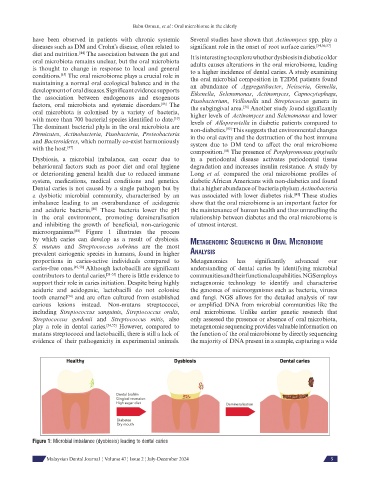
            microorganisms.   Figure 1 illustrates the process
            by which caries can develop as a result of dysbiosis.   MetagenoMIc sequencIng In oral MIcrobIoMe
            S. mutans  and  Streptococcus  sobrinus  are  the  most
            prevalent cariogenic species in humans, found in higher  analysIs
            proportions in caries-active individuals compared to  Metagenomics  has  significantly  advanced  our
            caries-free ones. [49,50]  Although lactobacilli are significant  understanding of dental caries by identifying microbial
            contributors to dental caries, [51-53]  there is little evidence to  communities and their functional capabilities. NGS employs
            support their role in caries initiation. Despite being highly  metagenomic  technology  to  identify  and  characterise
            aciduric and acidogenic, lactobacilli do not colonise  the genomes of microorganisms such as bacteria, viruses
            tooth enamel  and are often cultured from established  and fungi. NGS allows for the detailed analysis of raw
                       [54]
            carious lesions instead. Non-mutans streptococci,   or amplified DNA from microbial communities like the
            including  Streptococcus  sanguinis,  Streptococcus  oralis,  oral microbiome. Unlike earlier genetic research that
            Streptococcus gordonii and  Streptococcus mitis, also  only assessed the presence or absence of oral microbiota,
            play a role in dental caries. [54,55]  However, compared to  metagenomic sequencing provides valuable information on
            mutans streptococci and lactobacilli, there is still a lack of  the function of the oral microbiome by directly sequencing
            evidence of their pathogenicity in experimental animals.  the majority of DNA present in a sample, capturing a wide


            Figure 1: Microbial imbalance (dysbiosis) leading to dental caries


                    Malaysian Dental Journal  ¦ Volume 47 ¦ Issue 2 ¦ July-December 2024                      5

