


Page 22 - MDJ 2022 Jan-Jun, Volume 45 Number 1
P. 22
Lee / Ebin


                                                               dentists  in  the  East  Coast  of  Sabah.  There  were  similar
                                                               studies on patients requesting orthodontic treatment that
                                                               found less than half of the patients had definite orthodontic
                                                               treatment need. 7,18  Epidemiological studies also found less
                                                               than  half  of  the  patients  had  definite  treatment
                                                               need. 12,16,19,20

                                                                      Consideration of the perceived need of the patient
                                                               is important to increase mutually satisfying results for both
                                                                                       7
                                                               the  clinician  and  the  patient,   because  not  all  patients
                                                               would  agree  to  undergo  orthodontic  treatment  despite  a
                                                               definite  orthodontic  treatment  need.  There were  some
                                                                                             21
                                                               referred patients who refused orthodontic treatment, while
                                                               others  were  keen  to  have  treatment  even  for  mild
                                                                          22
                                                               malocclusion.
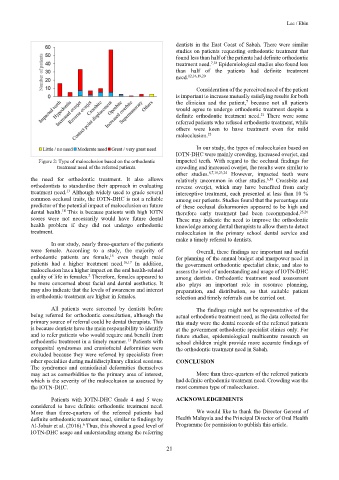
                                                                      In our study, the types of malocclusion based on
                                                               IOTN-DHC were mainly crowding, increased overjet, and
               Figure 2: Type of malocclusion based on the orthodontic   impacted teeth. With regard to the occlusal findings for
                     treatment need of the referred patients.   crowding and increased overjet, the results were similar to
                                                               other  studies. 6,7,18,23,24   However,  impacted  teeth  were
            the  need  for  orthodontic  treatment.  It  also  allows   relatively  uncommon  in  other  studies. 6,18  Crossbite and
            orthodontists to standardise their approach in evaluating   reverse  overjet,  which  may  have  benefited  from  early
                        13
            treatment need.  Although widely used to grade several   interceptive treatment, each presented at less than 10 %
            common occlusal traits, the IOTN-DHC is not a reliable   among our patients. Studies found that the percentage rate
            predictor of the potential impact of malocclusion on future   of  these occlusal  disharmonies  appeared  to  be high  and
            dental health.  This is because patients with high IOTN   therefore  early  treatment  had  been  recommended. 25,26
                       14
            scores  were  not  necessarily  would  have  future  dental   These may indicate the need to improve the orthodontic
            health problem  if  they  did not undergo orthodontic   knowledge among dental therapists to allow them to detect
            treatment.                                         malocclusion  in  the  primary  school  dental  service  and
                                                               make a timely referral to dentists.
                   In our study, nearly three-quarters of the patients
            were  female.  According  to  a  study,  the  majority  of      Overall, these findings are important and useful
                                        15
            orthodontic  patients  are  female,   even  though  male   for planning of the annual budget and manpower need in
            patients  had  a  higher  treatment  need. 16,17   In  addition,   the government orthodontic specialist clinic, and also to
            malocclusion has a higher impact on the oral health-related   assess the level of understanding and usage of IOTN-DHC
                                2
            quality of life in females.  Therefore, females appeared to   among  dentists.  Orthodontic  treatment  need  assessment
            be more concerned about facial and dental aesthetics. It   also  plays  an  important  role  in  resource  planning,
            may also indicate that the levels of awareness and interest   preparation,  and  distribution,  so  that  suitable  patient
            in orthodontic treatment are higher in females.    selection and timely referrals can be carried out.

                   All  patients  were  screened  by  dentists  before      The findings might not be representative of the
            being referred for orthodontic consultation, although the   actual orthodontic treatment need, as the data collected for
            primary source of referral could be dental therapists. This   this study were the dental records of the referred patients
            is because dentists have the main responsibility to identify   at the government orthodontic specialist clinics only. For
            and to refer patients who would require and benefit from   future  studies,  epidemiological  multicentre  research  on
                                              13
            orthodontic treatment in a timely manner.  Patients with   school children might provide more accurate findings of
            congenital  syndromes  and  craniofacial  deformities  were   the orthodontic treatment need in Sabah.
            excluded because they were referred by specialists from
            other specialties during multidisciplinary clinical sessions.   CONCLUSION
            The  syndromes  and  craniofacial  deformities  themselves
            may act as comorbidities to the primary area of interest,      More than three-quarters of the referred patients
            which is the severity of the malocclusion as assessed by   had definite orthodontic treatment need. Crowding was the
            the IOTN-DHC.                                      most common type of malocclusion.

                   Patients  with  IOTN-DHC  Grade  4  and  5  were   ACKNOWLEDGEMENTS
            considered  to  have  definite  orthodontic  treatment  need.
            More  than  three-quarters  of  the  referred  patients  had      We would like to thank the Director General of
            definite orthodontic treatment need, similar to findings by   Health Malaysia and the Principal Director of Oral Health
            Al-Jobair et al. (2016).  Thus, this showed a good level of   Programme for permission to publish this article.
                              6
            IOTN-DHC usage and understanding among the referring

                                                           21

