


Page 17 - MDJ 2022 Jan-Jun, Volume 45 Number 1
P. 17
Orthodontic Mini Implant: Malaysian perspective


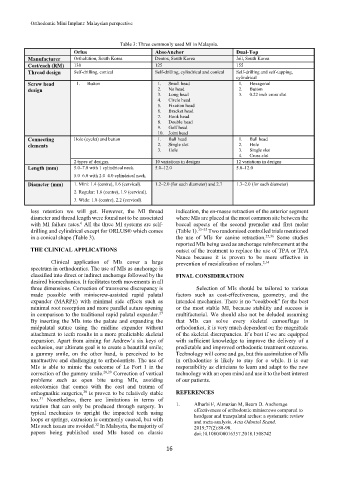
                                           Table 3: Three commonly used MI in Malaysia.
                           Orlus                        AbsoAnchor                  Dual-Top
           Manufacturer    Ortholution, South Korea     Dentos, South Korea         Jeil, South Korea
           Cost/each (RM)   130                         125                         155
           Thread design   Self-drilling, conical       Self-drilling, cylindrical and conical   Self-drilling and self-tapping,
                                                                                    cylindrical
           Screw head       1.   Button                 1.   Small head              1.   Hexagonal
           design                                       2.   No head                 2.   Button
                                                        3.   Long head               3.   0.22 inch cross slot
                                                        4.   Circle head
                                                        5.   Fixation head
                                                        6.   Bracket head
                                                        7.   Hook head
                                                        8.   Double head
                                                        9.   Golf head
                                                        10.  Joint head
           Connecting      Hole (eyelet) and button     1.   Ball head               1.   Ball head
           elements                                     2.   Single slot             2.   Hole
                                                        3.   Hole                    3.   Single slot
                                                                                     4.   Cross slot
                           2 types of designs.          10 variations in designs    12 variations in designs
           Length (mm)     5.0–7.0 with 1 cylindrical neck.   5.0–12.0              5.0–12.0
                           5.0–6.0 with 2.0–4.0 cylindrical neck.
           Diameter (mm)   1. Mini: 1.4 (centre), 1.6 (cervical).   1.2–2.0 (for each diameter) and 2.7   1.3–2.0 (for each diameter)
                           2. Regular: 1.6 (centre), 1.9 (cervical).
                           3. Wide: 1.8 (centre), 2.2 (cervical).

            less  retention  we  will  get.  However,  the  MI  thread   indication, the en-masse retraction of the anterior segment
            diameter and thread length were found not to be associated   where MIs are placed at the most common site between the
                             6
            with MI failure rates.  All the three MI systems are self-  buccal  aspects  of  the  second  premolar  and  first  molar
            drilling and cylindrical except for ORLUS® which comes   (Table 1). 33–35  Two randomised controlled trials mentioned
            in a conical shape (Table 3).                      the  use  of  MIs  for  canine  retraction. 25,36   Some  studies
                                                               reported MIs being used as anchorage reinforcement at the
            THE CLINICAL APPLICATIONS                          outset of the treatment to replace the use of TPA or TPA
                                                               Nance  because  it  is  proven  to  be  more  effective  in
                   Clinical application  of MIs cover a large   prevention of mesialization of molars. 2,14
            spectrum in orthodontics. The use of MIs as anchorage is
            classified into direct or indirect anchorage followed by the   FINAL CONSIDERATION
            desired biomechanics. It facilitates teeth movements in all
            three dimensions. Correction of transverse discrepancy is      Selection  of  MIs  should  be  tailored  to  various
            made  possible  with  miniscrew-assisted  rapid  palatal   factors  such  as  cost-effectiveness,  geometry,  and  the
            expander  (MARPE)  with  minimal  side  effects  such  as   intended mechanics. There is no “cookbook” for the best
            minimal root resorption and more parallel suture opening   or  the  most  stable  MI,  because  stability  and  success  is
                                                         27
            in comparison to the traditional rapid palatal expander.    multifactorial. We should also not be deluded assuming
            By  inserting  the  MIs  into  the  palate  and  expanding  the   that  MIs  can  solve  every  skeletal  camouflage  in
            midpalatal  suture  using  the  midline  expander  without   orthodontics, it is very much dependent on the magnitude
            attachment to teeth results in a more predictable skeletal   of the skeletal discrepancies. It’s best if we are equipped
            expansion. Apart from aiming for Andrew’s six keys of   with  sufficient  knowledge  to  improve  the  delivery  of  a
            occlusion, our ultimate goal is to create a beautiful smile;   predictable and improved orthodontic treatment outcome.
            a  gummy  smile,  on  the  other  hand,  is  perceived  to  be   Technology will come and go, but this assimilation of MIs
            unattractive and challenging to orthodontists. The use of   in  orthodontics  is  likely  to  stay  for  a  while.  It  is  our
            MIs  is able  to mimic the outcome of  Le  Fort  1  in the   responsibility as clinicians to learn and adapt to the new
            correction of the gummy smile. 28,29  Correction of vertical   technology with an open mind and use it to the best interest
            problems  such  as  open  bite  using  MIs,  avoiding   of our patients.
            osteotomies  that  comes  with  the  cost  and  trauma  of
                              30
            orthognathic surgeries,  is proven to be relatively stable   REFERENCES
            too.   Nonetheless,  there  are  limitations  in  terms  of
               31
            rotation  that  can  only  be  produced  through  surgery.  In   1.    Alharbi F, Almuzian M, Bearn D. Anchorage
            typical  mechanics  to  upright  the  impacted  teeth  using   effectiveness of orthodontic miniscrews compared to
                                                                     headgear and transpalatal arches: a systematic review
            loops or springs, extrusion is commonly caused, but with   and meta-analysis. Acta Odontol Scand.
                                  32
            MIs such issues are avoided.  In Malaysia, the majority of   2019;77(2):88-98.
            papers  being  published  used  MIs  based  on  classic   doi:10.1080/00016357.2018.1508742

                                                           16

