


Page 21 - MDJ 2022 Jan-Jun, Volume 45 Number 1
P. 21
Orthodontic Treatment Need of the Referred Patients in the East Coast of Sabah


                            7
            treatment  planning,   and  to  reduce  subjectivity  in  the   Table 1: Demographic profiles of the patients.
                                                   12
            measurement and assessment among individuals.
                                                                Variables                n (%)    Mean ± SE
                   This research was done based on the localities of   Age                 -      16.89 ± 0.37
            the researchers. Currently in the East Coast of Sabah there                   101
            are  only  two  orthodontic  specialist  clinics,  located  in   Gender   Female   (73.19)   -
            Sandakan  and  Tawau.  These  clinics  provide  specialist                     37
            orthodontic  services  under  the  Ministry  of  Health         Male         (26.81)
            Malaysia.  The  orthodontic  referrals  came  from  dental                     68
            practitioners  in  Sandakan,  Tawau,  Lahad  Datu,    Ethnicity   Chinese    (49.28)      -
            Kinabatangan,  Beluran,  Telupid,  Tongod,  Kunak,  and         Bumiputera     55
            Semporna.
                                                                            Sabah        (39.86)
                   The aim of  this study  was to  assess the               O  t  h  e  r  s     15
            orthodontic treatment need of the referred patients in the                   (10.87)
            East Coast of Sabah. The outcome of this study would be   Primary             128
            beneficial in planning the annual budget and manpower   source of   Dentists   (92.75)    -
            need in the government orthodontic specialist clinic. It also   referral
            serves as a justification tool for allocation under the finite      O  t  h  e  r  s     10
            resources  in  the  Ministry  of  Health.  In  addition,  the                (7.25)
            outcome  might  be  useful  to  assess  the  level  of
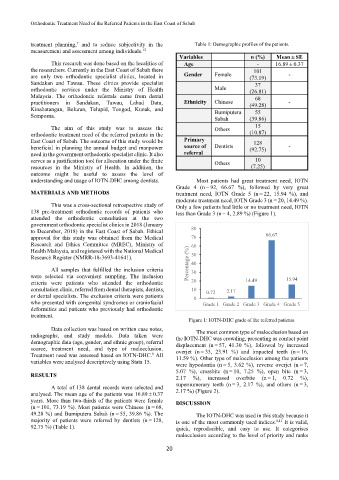
            understanding and usage of IOTN-DHC among dentists.       Most  patients  had  great  treatment  need,  IOTN
                                                               Grade  4  (n = 92,  66.67  %),  followed  by  very  great
            MATERIALS AND METHODS                              treatment  need,  IOTN  Grade  5  (n = 22,  15.94  %),  and
                                                               moderate treatment need, IOTN Grade 3 (n = 20, 14.49 %).
                   This was a cross-sectional retrospective study of   Only a few patients had little or no treatment need, IOTN
            138  pre-treatment  orthodontic  records  of  patients  who   less than Grade 3 (n = 4, 2.89 %) (Figure 1).
            attended  the  orthodontic  consultation  at  the  two
            government orthodontic specialist clinics in 2018 (January
            to December, 2018) in the East Coast of Sabah. Ethical   80
            approval  for  this  study  was  obtained  from  the  Medical   70                66.67
            Research  and  Ethics  Committee  (MREC),  Ministry  of   60
            Health Malaysia, and registered with the National Medical
            Research Register (NMRR-18-3693-41641).                 50
                   All  samples  that  fulfilled  the  inclusion  criteria   Percentage (%)  40
                                                                    30
            were  selected  via  convenient  sampling.  The  inclusion                               15.94
            criteria  were  patients  who  attended  the  orthodontic   20             14.49
            consultation clinic, referred from dental therapists, dentists,   10  2.17
            or dental specialists. The exclusion criteria were patients   0  0.72
            who presented with congenital syndromes or craniofacial     Grade 1 Grade 2 Grade 3 Grade 4 Grade 5
            deformities and patients who previously had orthodontic
            treatment.
                                                                   Figure 1: IOTN-DHC grade of the referred patients.
                   Data collection was based on written case notes,      The most common type of malocclusion based on
            radiographs,  and  study  models.  Data  taken  were   the IOTN-DHC was crowding, presenting as contact point
            demographic data (age, gender, and ethnic group), referral   displacement  (n = 57,  41.30  %),  followed  by  increased
            source,  treatment  need,  and  type  of  malocclusion.   overjet  (n = 33,  23.91  %)  and  impacted  teeth  (n = 16,
                                                      9
            Treatment need was assessed based on IOTN-DHC.  All   11.59 %). Other type of malocclusion among the patients
            variables were analysed descriptively using Stata 15.
                                                               were  hypodontia  (n = 5,  3.62  %),  reverse  overjet  (n = 7,
                                                               5.07  %),  crossbite  (n = 10,  7.25  %),  open  bite  (n = 3,
            RESULTS
                                                               2.17  %),  increased  overbite  (n = 1,  0.72  %),
                                                               supernumerary  teeth  (n = 3,  2.17  %),  and  others  (n = 3,
                   A total of 138 dental records were selected and
            analysed. The mean age of the patients was 16.89 ± 0.37   2.17 %) (Figure 2).
            years. More than two-thirds of the patients were female   DISCUSSION
            (n = 101, 73.19 %). Most patients were Chinese (n = 68,
            49.28 %) and Bumiputera Sabah (n = 55, 39.86 %). The      The IOTN-DHC was used in this study because it
            majority  of  patients  were  referred  by  dentists  (n = 128,   is one of the most commonly used indices. 8,11  It is valid,
            92.75 %) (Table 1).                                quick,  reproducible,  and  easy  to  use.  It  categorises
                                                               malocclusion according to the level of priority and ranks

                                                           20

