


Page 26 - MDJ 2022 Jan-Jun, Volume 45 Number 1
P. 26
Ganapathy / Ibrahim


            Study Patient                                      Statistical Analysis

                   The calculated sample size was 384, based on the      Statistical  Package  for  Social  Science  (SPSS)
            calculation of Klang district’s population of 879867 with   version 22 (IBM, New York) was used for all statistical
            a confidence interval of 95 % and a 5 % margin of error.   analyses.  Descriptive  data  was  expressed  as  mean  ±
            Inclusion  criteria  were:  (1)  all  patients  who  underwent   standard deviation (SD) unless otherwise stated. Kruskal-
            complete RCT with RDITN scoring in the Restorative Unit,   Wallis, Spearman’s rank log coefficient, Mann-Whitney,
            Pandamaran  Dental  Clinic  from  2017-2019,  and  (2)   Chi-Square test, and Fisher’s exact test were used due to
            patients  with  RDITN  score  in  their  referral  letter.   non-normally  distributed  data  depending  on  the  type  of
            Exclusion criteria were (1) patients who defaulted follow   variables and appropriateness. Simple logistic and linear
            up post endodontic restoration and (2) patients who had   regression were applied to measure the associations and
            not given any consent.  Withdrawal criteria  were also   predictions  of  certain  independent  variables  with  the
            included as participants could choose to withdraw at any   dependent  variable.  A  value  of  p < 0.05  is  considered
            time. Participants were removed if the investigator deemed   statistically significant. The data collected was analysed
            that  it  was  detrimental  or  risky  for  the  participant  to   using an intention-to-treat basis.
            continue.
                                                               RESULTS
            Data Collection
                                                               Distribution  of  Patients  According  to  Demographic/
                   Patients who had a RDITN score and had already   Characteristics among RDITN-Endo Score
            completed  endodontic  treatment  were  recruited  after
            meeting the inclusion and exclusion criteria. The patient      A total of 104 patients participated in this study.
            completed the S-OHIP(M) questionnaire after arrival on   Table 1 illustrates the distribution of patients according to
            their  given  appointment  date  with  the  completion  of   demographics,  medical  history,  and  presence  of
            written consent. Patients who had endodontic retreatment   comorbidities. A majority of the patients included in the
            or extraction of the treated tooth were noted as failure of   study  were  female.  Accordingly,  females  dominated
            treatment. Data taken was recorded and was organised in   within each RDITN-Endo score. Most patients in the study
            a data collection sheet. Patient information and data were   have  no  history  of  allergy,  prior  medication  intake,  or
            kept confidential before and after data collection. To avoid   underlying comorbidities.
            assessment bias, each patient’s name was replaced with a
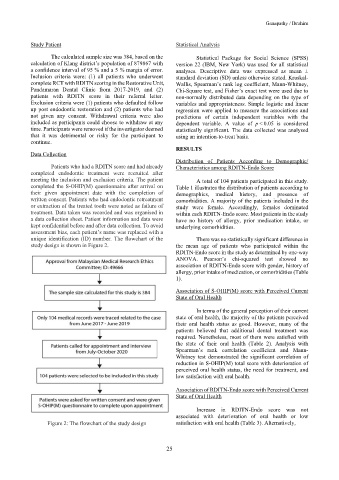
            unique identification (ID) number. The flowchart of the      There was no statistically significant difference in
            study design is shown in Figure 2.                 the  mean  age  of  patients  who  participated  within  the
                                                               RDITN-Endo score in the study as determined by one-way
                                                               ANOVA.  Pearson’s  chi-squared  test  showed  no
                                                               association of RDITN-Endo score with gender, history of
                                                               allergy, prior intake of medication, or comorbidities (Table
                                                               1).

                                                               Association of S-OHIP(M) score with Perceived Current
                                                               State of Oral Health

                                                                      In terms of the general perception of their current
                                                               state of oral health, the majority of the patients perceived
                                                               their  oral  health  status  as  good.  However,  many  of  the
                                                               patients  believed  that  additional  dental  treatment  was
                                                               required. Nonetheless, most of them were satisfied with
                                                               the  state  of  their  oral  health  (Table  2).  Analysis  with
                                                               Spearman’s  rank  correlation  coefficient  and  Mann-
                                                               Whitney  test demonstrated  the  significant  correlation of
                                                               reduction in S-OHIP(M) total score with deterioration of
                                                               perceived oral health status, the need for treatment, and
                                                               low satisfaction with oral health.

                                                               Association of RDITN-Endo score with Perceived Current
                                                               State of Oral Health

                                                                      Increase  in  RDITN-Endo  score  was  not
                                                               associated  with  deterioration  of  oral  health  or  low
                  Figure 2: The flowchart of the study design   satisfaction with oral health (Table 3). Alternatively,


                                                           25

