


Page 28 - MDJ 2022 Jan-Jun, Volume 45 Number 1
P. 28
Ganapathy / Ibrahim


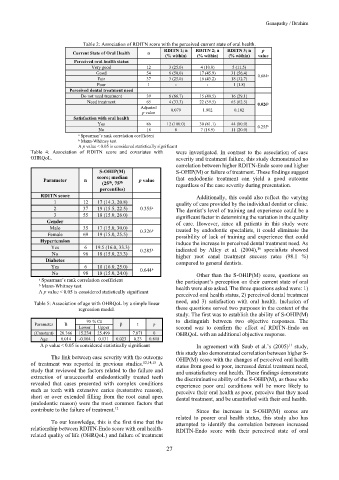
                              Table 2: Association of RDITN score with the perceived current state of oral health.
                                                           RDITN 1; n   RDITN 2; n   RDITN 3; n   p
                           Current State of Oral Health   n
                                                           (% within)   (% within)   (% within)   value
                           Perceived oral health status
                                 Very good          12      3 (25.0)   4 (10.8)    5 (11.5)
                                   Good             54      6 (50.0)   17 (45.9)   31 (56.4)   0.684ᵃ
                                   Fair             37      3 (25.0)   16 (43.2)   18 (32.7)
                                   Poor              1         -          -        1 (1.8)
                         Perceived dental treatment need
                             Do not need treatment   39     8 (66.7)   15 (40.5)   16 (29.1)
                                Need treatment      65      4 (33.3)   22 (59.5)   65 (62.5)   0.026ᵇ
                                                  Adjusted
                                                             0.079      1.902      0.182
                                                   p value
                           Satisfaction with oral health
                                   Yes              86      12 (100.0)   30 (81.1)   44 (80.0)   0.255ᵇ
                                    No              18        0        7 (18.9)   11 (20.0)
                             ᵃ Spearman’s rank correlation coefficient
                             ᵇ Mann-Whitney test
                             A p value < 0.05 is considered statistically significant
            Table  4:  Association  of  RDITN  score  and  covariates  with   were  investigated.  In  contrast  to  the  association of  case
            OHRQoL.                                            severity and treatment failure, this study demonstrated no
                                                               correlation between higher RDITN-Endo score and higher
                                    S-OHIP(M)                  S-OHIP(M) or failure of treatment. These findings suggest
                                   score; median               that  endodontic  treatment  can  yield  a  good  outcome
                Parameter      n                  p value
                                           th
                                     (25 , 75                  regardless of the case severity during presentation.
                                       th
                                    percentiles)
               RDITN score                                            Additionally, this could also reflect the varying
                    1         12   17 (14.3, 20.8)             quality of care provided by the individual dentist or clinic.
                    2         37   19 (15.5, 22.5)   0.355ᵃ    The dentist’s level of training and experience could be a
                    3         55   18 (15.0, 26.0)             significant factor in determining the variation in the quality
                 Gender                                        of  care.  However,  since  all  patients  in  this  study  were
                   Male       35   17 (15.0, 30.0)   0.326ᵇ    treated  by  endodontic  specialists,  it  could  eliminate  the
                  Female      69   19 (15.0, 25.5)             possibility of lack of training and experience that could
               Hypertension                                    induce the increase in perceived dental treatment need. As
                   Yes         6   19.5 (16.0, 33.3)   0.283ᵇ   indicated  by  Alley  et  al.  (2004),   specialists  showed
                                                                                           16
                   No         98   18 (15.0, 23.3)             higher  root  canal  treatment  success  rates  (98.1  %)
                 Diabetes                                      compared to general dentists.
                   Yes         6   18 (16.0, 25.0)
                   No         98   18 (15.0, 24.0)   0.644ᵇ           Other  than  the  S-OHIP(M)  score,  questions  on
               ᵃ Spearman’s rank correlation coefficient       the participant’s perception on their current state of oral
               ᵇ Mann-Whitney test                             health were also asked. The three questions asked were: 1)
               A p value < 0.05 is considered statistically significant
                                                               perceived oral health status, 2) perceived dental treatment
             Table 5: Association of age with OHRQoL by a simple linear   need,  and  3)  satisfaction  with  oral  health.  Inclusion  of
                             regression model.                 these questions served two purposes in the context of the
                                                               study. The first was to establish the ability of S-OHIP(M)
                               95 % CI                         to  distinguish  between  two  objective  responses.  The
             Parameter   B                 β     t     p
                             Lower   Upper                     second  was  to  confirm  the  effect  of  RDITN-Endo  on
             (Constant)   20.366   15.234   25.499      7.871   0   OHRQoL with an additional objective response.
               Age    0.014   -0.104   0.131   0.023   0.23   0.818
                A p value < 0.05 is considered statistically significant      In agreement with Saub et al.’s (2005)  study,
                                                                                                      11
                                                               this study also demonstrated correlation between higher S-
                   The link between case severity with the outcome   OHIP(M) score with the changes of perceived oral health
            of  treatment  was  reported  in  previous  studies. 12,14,15   A   status from good to poor, increased dental treatment need,
            study that reviewed the factors related to the failure and   and unsatisfactory oral health. These findings demonstrate
            extraction  of  unsuccessful  endodontically  treated  teeth   the discriminative ability of the S-OHIP(M), as those who
            revealed  that  cases  presented  with  complex  conditions   experience  poor  oral  conditions  will  be  more  likely  to
            such  as  teeth  with  extensive  caries  (restorative  reason),   perceive their oral health as poor, perceive that they need
            short  or  over  extended  filling  from  the  root  canal  apex   dental treatment, and be unsatisfied with their oral health.
            (endodontic reason) were the most common factors that
            contribute to the failure of treatment.                   Since  the  increase  in  S-OHIP(M)  scores  are
                                         12
                                                               related  to  poorer  oral  health  status,  this  study  also  has
                   To our knowledge, this is the first time that the   attempted  to  identify  the  correlation  between  increased
            relationship between RDITN-Endo score with oral health-  RDITN-Endo  score  with  their  perceived  state  of  oral
            related quality of life (OHRQoL) and failure of treatment

                                                           27

