


Page 33 - MDJ 2022 Jan-Jun, Volume 45 Number 1
P. 33
Radiographic Assessment of the Technical Quality of Failed Endodontic Treatment Referred from General Dental Practitioners in
            Pahang, Malaysia: A retrospective study

            posterior).  A  p value equal to  or less  than 0.05  was   fillings,  80.0 %  were  inadequate  (Table  5).  Maxillary
            considered statistically significant.              incisors  had  the  highest  frequency  of  inadequate  root
                                                               fillings  at  49.2 %,  followed  by  mandibular  molars
               Table 2: Distribution of root treated teeth in both jaws.   (21.2 %), and maxillary premolars (12.9 %). Adequacy of
                                                               root canal fillings was also assessed in relation to tooth
                  Tooth type            n           %          group. There was no statistically significant difference (p >
               Maxillary incisors      88          53.3        0.05) in quality of root canal fillings among the different
               Maxillary canines        1          0.6         tooth groups.
              Maxillary premolars      18          10.9
                Maxillary molars        9          5.5          Table 3: Distribution of root-treated teeth in relation to tooth
              Total maxillary teeth    116         70.3                            position.
              Mandibular incisors       3          1.8                Tooth position         n          %
               Mandibular canines       1          0.6              Maxillary anterior       8  9      5  3  .  9
              Mandibular premolars     13          7.9              Maxillary posterior      2  7      1  6  .  4
               Mandibular molars       32          19.4             Mandibular anterior      4          2  .  4
             Total mandibular teeth    49          29.7            Mandibular posterior      4  5      2  7  .  3

            RESULTS                                                      Healthcare Sector Where Initial
                                                                           Endodontic Treatment Was
                  The subjects’ ages ranged from 11 to 71 years old,              Performed
            76 (46.1 %) were male and 89 (53.9 %) were female. The
            distribution of the root-treated teeth is as tabulated in Table
            2. The tooth most often referred for retreatment was the            Missing
            maxillary  incisor  (53.3 %),  while  maxillary  and                  9%
            mandibular canines were the least referred (0.6 %). As a
            group, more maxillary teeth were referred for retreatment
            (70.3 %)  compared  to  mandibular  teeth  (29.7 %).  In
            relation to tooth position, more maxillary anteriors (53.9 %)   Private           Govern
            needed  retreatment  compared  to  mandibular  anteriors      36%                  ment
            (2.4 %) while more mandibular molars (27.3 %) needed                               55%
            retreatment compared to maxillary molars (16.4 %) (Table
            3).
                   Symptoms  in  the  form  of  pain,  discomfort,
            swelling, or a combination of symptoms were noted in 105
            cases (63.6 %) while 60 cases (36.4 %) had no symptoms.       Government  Private  Missing
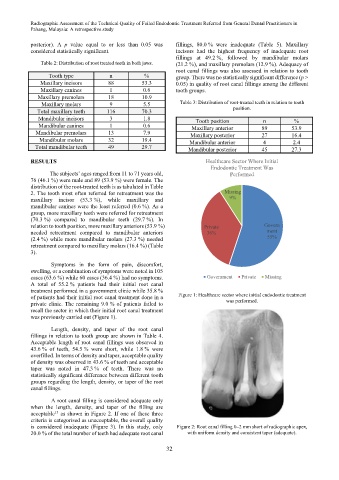
            A  total  of  55.2 %  patients  had  their  initial  root  canal
            treatment performed in a government clinic while 35.8 %
            of patients had their initial root canal treatment done in a   Figure 1: Healthcare sector where initial endodontic treatment
            private clinic. The remaining 9.0 % of patients failed to           was performed.
            recall the sector in which their initial root canal treatment
            was previously carried out (Figure 1).

                   Length,  density,  and  taper  of  the  root  canal
            fillings in relation to tooth group are shown in Table 4.
            Acceptable length of root canal fillings was observed in
            43.6 %  of  teeth,  54.5 %  were  short,  while  1.8 %  were
            overfilled. In terms of density and taper, acceptable quality
            of density was observed in 43.6 % of teeth and acceptable
            taper  was  noted  in  47.3 %  of  teeth.  There  was  no
            statistically significant difference between different tooth
            groups regarding the length, density, or taper of the root
            canal fillings.

                   A root canal filling is considered adequate only
            when  the  length,  density,  and  taper  of  the  filling  are
                    15
            acceptable  as shown in Figure 2. If one of these three
            criteria is categorised as unacceptable, the overall quality
            is  considered  inadequate  (Figure  3).  In  this  study,  only   Figure 2: Root canal filling 0–2 mm short of radiographic apex,
            20.0 % of the total number of teeth had adequate root canal   with uniform density and consistent taper (adequate).


                                                           32

