


Page 32 - MDJ 2022 Jan-Jun, Volume 45 Number 1
P. 32
Ahmad / Sebastian Rajah


            coronal leakage may be an important cause of failure of   treatments  group.  These  root  canal  fillings  showed
                             5
            endodontic treatment.                              obturations that were short of radiographic apex, presence
                                                               of voids, and presence of periapical radiolucency. All these
                   There are also some cases in which the treatment   failed  root-treated  teeth  were  recorded  in  a  logbook
            has  followed  the  highest  technical  standards  and  yet   prepared by this unit since 2009. A final sample of 165
            resulted in failure. Scientific evidence indicates that some   root-treated teeth were chosen after careful selection. Only
            factors may be associated with the unsatisfactory outcome   clearly visible radiographs which include the whole root
            of  well-treated  cases,  including  extraradicular  infection,   length  and  at  least  2 mm  of  the  periapical  region  were
                                          6–8
            foreign body reactions, and true cysts.  According to the   selected. Poor quality radiographs as well as cases with
            European Society of Endodontology,  root canal treatment   iatrogenic  errors  such  as  perforations,  separated
                                         9
            has an unfavourable outcome when:                  instruments, and crown-root fractures were excluded. All
                                                               radiographs included were in the form of periapical films.
            (1)  the  tooth  is  associated  with  signs  and  symptoms  of
            infection;                                           Table 1: Criteria followed to record information from radiographs.
            (2) a radiologically visible lesion has appeared subsequent
            to treatment or a pre- existing lesion has increased in size;   Variable   Criteria   Definition
            (3)  a  lesion  has  remained  the  same  size  or  has  only   Acceptable   Root filling ending ≤ 2 mm
            diminished in size during the 4-year assessment period;                      from radiographic apex
            (4) signs of continuing root resorption are present.   Length of           Root filling ending > 2 mm
                                                                 root canal   Under      from radiographic apex
                   The  primary  root  canal  treatment  yields    filling             Root filling ending beyond
                                                         10
            predictable results and is a highly successful procedure          Over       the radiographic apex
                                                         11
            with  a  survival  rate  of  95 %  after  a  4-year  follow-up.              Uniform density of root
            However,  based  on  the  ‘Failed  Endodontically  Treated     Acceptable   filling without voids and
            Teeth’  logbook  prepared  by  this  unit,  the  number  of   Density       canal space is not visible
            referred  cases  increased  within  the  nine  year  period  of   of root   Not uniform density of root
            2009 to 2017. Whenever an endodontic treatment fails, it   canal
            is  generally  agreed  that  the  optimal  approach  is  to   filling   Poor   filling, clear presence of
                                                                                         voids and canal space is
            undertake  non-surgical  retreatment,  but  retreatment  of
                                                         12
            failed  cases  is  challenging  and  time  consuming.                              visible
            Moreover, the pooled estimated success rate of secondary                    Consistent taper from the
            root canal treatment can drop to 77 %.                         Acceptable   coronal to apical part of the
                                          13
                                                                  Taper of             filling, reflects well to canal
                   The quality of root canal treatment undertaken by   root canal               shape
            general dental practitioners (GDP) in different populations   filling      Inconsistent taper from the
            has  been  extensively  investigated, 14–21   though  not  in     Poor     coronal to the apical part of
            Malaysia. The results from these studies showed a high                            the filling
            range of 43.7 to 75.4 % of inadequate root canal treatment.
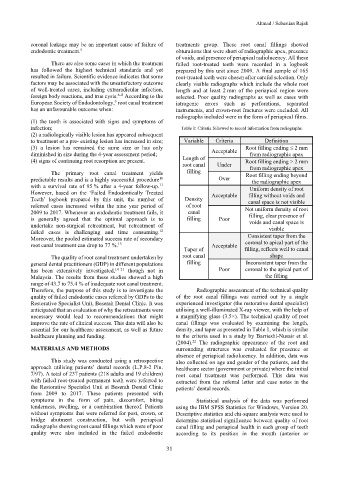
            Therefore, the purpose of this study is to investigate the      Radiographic assessment of the technical quality
            quality of failed endodontic cases referred by GDPs to the   of  the  root  canal  fillings  was  carried  out  by  a  single
            Restorative Specialist Unit, Beserah Dental Clinic. It was   experienced investigator (the restorative dental specialist)
            anticipated that an evaluation of why the retreatments were   utilising a well-illuminated X-ray viewer, with the help of
            necessary  would  lead  to  recommendations  that  might   a magnifying glass (3.5×). The technical quality of root
            improve the rate of clinical success. This data will also be   canal  fillings  was  evaluated  by  examining  the  length,
            essential for our healthcare assessment, as well as future   density, and taper as presented in Table 1, which is similar
            healthcare planning and funding.                   to the criteria used in a study by Barrieshi-Nusair et al.
                                                               (2004).   The  radiographic  appearance  of  the  root  and
                                                                     22
            MATERIALS AND METHODS                              surrounding  structures  was  evaluated  for  presence  or
                                                               absence of periapical radiolucency. In addition, data was
                   This study was conducted using a retrospective   also collected on age and gender of the patients, and the
            approach  utilising  patients’  dental  records  (L.P.8-2  Pin.   healthcare sector (government or private) where the initial
            7/97). A total of 237 patients (218 adults and 19 children)   root  canal  treatment  was  performed.  This  data  was
            with failed root-treated permanent teeth were referred to   extracted  from  the  referral  letter  and  case  notes  in  the
            the Restorative Specialist Unit at Beserah Dental Clinic   patients’ dental records.
            from  2009  to  2017.  These  patients  presented  with
            symptoms  in  the  form  of  pain,  discomfort,  biting      Statistical  analysis  of  the  data  was  performed
            tenderness,  swelling,  or  a  combination  thereof.  Patients   using the IBM SPSS Statistics for Windows, Version 20.
            without symptoms that were referred for post, crown, or   Descriptive statistics and chi-square analysis were used to
            bridge  abutment  construction,  but  with  periapical   determine statistical significance between quality of root
            radiographs showing root canal fillings which were of poor   canal filling and periapical health in each group of teeth
            quality  were  also  included  in  the  failed  endodontic   according  to  its  position  in  the  mouth  (anterior  or


                                                           31

