


Page 42 - MDJ 2022 Jan-Jun, Volume 45 Number 1
P. 42
Said Gulam Khan / Khor / Mohd Sarmin / Jambai / Mohd Azlan / Nordin


            DMSO.  The  sub-cultured  bacteria  were  inoculated  into   concentration  of  the  extract  that  showed  no  bacterial
            BHI  broth  and  the  number  of  bacterial  cells  in  the   growth on agar medium was considered as the MBC. The
            suspension  were  standardized  to  0.08–0.13  using  a   test was done in triplicate.
                                                          8
            spectrophotometer (OD 625 nm) which is equivalent to 10
            cells/mℓ. Actively growing cultures were inoculated on a   RESULTS
            BHI agar plate. The disc with extract and controls were
            placed aseptically on the inoculated medium. The plates   AST of Ethanolic Extract of Z. mauritiana Leaves against
            were  incubated  at  37 °C  for  24–48  hours.  The   S. mutans
            antimicrobial  activity  was  evaluated  by  measuring  the
            diameter of the zones of inhibition, taken in three different      The antibacterial activity of the extract was tested
            directions. All tests were performed in triplicate.    against S. mutans by disc diffusion method in the presence
                                                   14
                                                               of  positive  control  (CHX)  and  negative  control  (20 %
            Minimum Inhibitory Concentration (MIC)             DMSO). The zone of inhibition was observed surrounding
                                                               the disc consisting of 200 and 500 mg/mℓ of Z. mauritiana
                   The antimicrobial activity of the ethanolic extract   leaf ethanolic extract (Figure 4).
            of Z. mauritiana leaves was further analysed using MIC
            assay (CLSI, 2018). The concentration of the extract that   Table 1: AST result of S. mutans against ethanolic extract
            inhibits  the  growth  of  the  bacteria  from  disc  diffusion   of Z. mauritiana leaves.
            method  was  used  for  the  MIC  assay.  Determination  of
            MIC of the extract was taken as the lowest concentration                   Zone of Inhibition (mm)
            of the extract showing no visible growth of the organism   Impregnated Disc   Plate   Plate   Plate   Mean
            by standard micro-assays using sterile 96-well microplates.              1      2     3      (SD)
            The sub-cultured bacteria were inoculated into BHI broth   Positive   CHX   27   26   26    26.33 ±
            and the number of bacterial cells in the suspension was   control                            0.58
            standardized  to  0.08–0.13  using  a  spectrophotometer   Negative   20 %   0   0    0     0 ± 0.0
                                             8
            (OD 625 nm)  which  is  equivalent  to  10  cells/mℓ.  The   control   DMSO
            standardized suspension was diluted to a ratio of 1:20 to        500    13.5   14.5   13.7   13.9 ±
            yield 10  cells/mℓ. The plant extracts were serially diluted   Z.   mg/mℓ                    0.53
                  6
            in the 96-well with final concentration of extract ranging   mauritiana   200   12   12   11   11.67 ±
            from 200 to 0.1 mg/mℓ. The micro titre plate was labelled      mg/mℓ                         0.58
            with number 1 until 12. 100 µℓ of BHI broth was pipetted
            into all the wells (wells numbers 1 to 12). Then, 100 µℓ of
            400  mg/mℓ  of  the  plant  extract  was  pipetted  into  well
            number 1 as a starting concentration for MIC assay. Next,
            a  two-fold  serial  dilution  was  conducted  by  pipetting
            100 µℓ  of  the  mixture  from  well  number  1  into  well   W                                 X
            number 2. The diluted solutions were mixed well, and this
            process was repeated until well number 11. The remaining
            100 µℓ of the diluted extracts were discarded. After that
            10 µℓ of bacterial suspensions (10  cells/mℓ) were added                                        Y
                                        8
            into well 1 until well 12. Well number 12 was used as a
            control  test  for  bacteria  growth  without  plant  extract.
            Serial dilution of the extract was prepared as blank at the                                     Z
            last row of the plate. Three wells were used as sterility
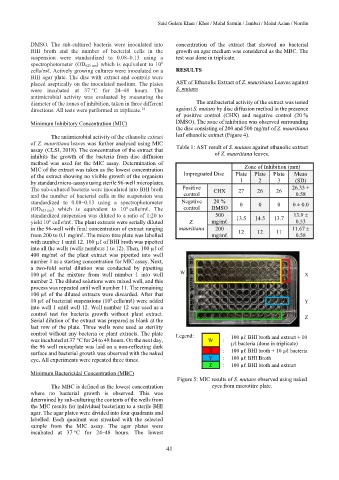
            control without any bacteria or plant extracts. The plate   Legend:
            was incubated at 37 °C for 24 to 48 hours. On the next day,   W    :   100 µℓ BHI broth and extract + 10
            the 96 well microplate was laid on a non-reflecting dark              µℓ bacteria (done in triplicate)
            surface and bacterial growth was observed with the naked      X    :  100 µℓ BHI broth + 10 µℓ bacteria
            eye. All experiments were repeated three times.               Y    :  100 µℓ BHI Broth
                                                                          Z    :  100 µℓ BHI broth and extract
            Minimum Bactericidal Concentration (MBC)
                                                               Figure 5: MIC results of S. mutans observed using naked
                   The MBC is defined as the lowest concentration          eyes from microtitre plate.
            where  no  bacterial  growth  is  observed.  This  was
            determined by sub-culturing the contents of the wells from
            the MIC results for individual bacterium to a sterile BHI
            agar. The agar plates were divided into four quadrants and
            labelled.  Each  quadrant  was  streaked  with  the  selected
            sample  from  the  MIC  assay.  The  agar  plates  were
            incubated  at  37 °C  for  24–48  hours.  The  lowest


                                                           41

