


Page 44 - MDJ 2022 Jan-Jun, Volume 45 Number 1
P. 44
Said Gulam Khan / Khor / Mohd Sarmin / Jambai / Mohd Azlan / Nordin


                                                               extraction, and is safe for human consumption.  It is also
                                                                                                     19
                                                               the most commonly used solvent other than aqueous and
                                                               methanol.  Many  studies  have  shown  positive  effects  of
                                                               antimicrobial property in correlation to using ethanol as a
                                                               solvent. It has been reported by Valle et al. (2016),  that
                                                                                                        20
                                                               the  ethanol  extract  proved  to  be  more  potent  than  the
                                                               methanol. This is proven with the increasing diameter of
                                                               inhibitory  zone  as  the  concentration  of  the  extract
                                                               increases.  The  minimum  inhibitory  concentration  and
                                                               minimum bactericidal concentration tests were conducted
                                                               in order to determine the lowest concentration that inhibits
                                                               and kills the bacteria respectively. It shows that ethanolic
                                                               extracts of Ziziphus mauritiana leaves can inhibit and kill
                                                               the  growth  of  S. mutans  at  the  concentration  of
                                                               3.125 mg/mℓ. Thus, this  extract exhibits a bactericidal
                                                               effect on this cariogenic bacterium. Other studies reported
                                                               the antibacterial activity of ethanolic extracts of Ziziphus
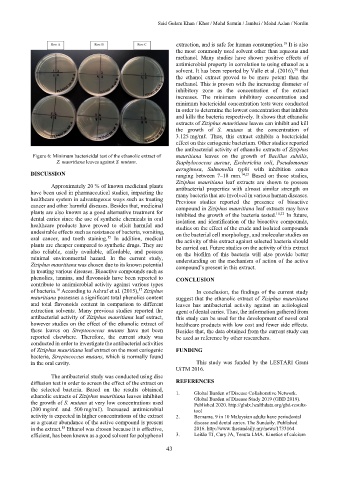
             Figure 6: Minimum bactericidal test of the ethanolic extract of   mauritiana  leaves  on  the  growth  of  Bacillus subtilis,
                     Z. mauritiana leaves against S. mutans.   Staphylococcus aureus,  Escherichia coli,  Pseudomonas
                                                               aeruginosa,  Salmonella typhi  with  inhibition  zones
            DISCUSSION                                         ranging  between  7–18  mm. 14,21   Based  on  those  studies,
                                                               Ziziphus mauritiana  leaf  extracts  are  shown  to  possess
                   Approximately 20 % of known medicinal plants   antibacterial  properties  with  almost  similar  strength  on
            have been used in pharmaceutical studies, impacting the   many bacteria that are involved in various human diseases.
            healthcare system in advantageous ways such as treating   Previous  studies  reported  the  presence  of  bioactive
            cancer and other harmful diseases. Besides that, medicinal   compound in Ziziphus mauritiana leaf extracts may have
            plants are also known as a good alternative treatment for   inhibited the growth of the bacteria tested. 14,22  In future,
            dental caries since the use of synthetic chemicals in oral   isolation  and  identification  of  the  bioactive  compounds,
            healthcare  products  have  proved  to  elicit  harmful  and   studies on the effect of the crude and isolated compounds
            undesirable effects such as resistance of bacteria, vomiting,   on the bacterial cell morphology, and molecular studies on
                                       15
            oral  cancer,  and  tooth  staining.   In  addition,  medical   the activity of this extract against selected bacteria should
            plants are cheaper compared to synthetic drugs. They are   be carried out. Future studies on the activity of this extract
            also  reliable,  easily  available,  affordable,  and  possess   on  the  biofilm  of  this  bacteria  will  also  provide  better
            minimal  environmental  hazard.  In  the  current  study,   understanding on the mechanism of action of the active
            Ziziphus mauritiana was chosen due to its known potential   compound’s present in this extract.
            in treating various diseases. Bioactive compounds such as
            phenolics, tannins, and flavonoids have been reported to   CONCLUSION
            contribute to antimicrobial activity against various types
                                                  17
                     16
            of bacteria.  According to Ashraf et al. (2015),  Ziziphus      In conclusion, the findings of the current study
            mauritiana possesses a significant total phenolics content   suggest that the ethanolic extract of Ziziphus mauritiana
            and  total  flavonoids  content  in  comparison  to  different   leaves  has  antibacterial  activity  against  an  aetiological
            extraction  solvents.  Many  previous  studies  reported  the   agent of dental caries. Thus, the information gathered from
            antibacterial activity of Ziziphus mauritiana leaf extract,   this study can be used for the development of novel oral
            however studies on the effect of the ethanolic extract of   healthcare products with low cost and fewer side effects.
            these  leaves  on  Streptococcus mutans  have  not  been   Besides that, the data obtained from the current study can
            reported  elsewhere.  Therefore,  the  current  study  was   be used as reference by other researchers.
            conducted in order to investigate the antibacterial activities
            of Ziziphus mauritiana leaf extract on the most cariogenic   FUNDING
            bacteria, Streptococcus mutans, which is normally found
            in the oral cavity.                                       This study was funded by the LESTARI Grant
                                                               UiTM 2016.
                   The antibacterial study was conducted using disc
            diffusion test in order to screen the effect of the extract on   REFERENCES
            the  selected  bacteria.  Based  on  the  results  obtained,
            ethanolic extracts of Ziziphus mauritiana leaves inhibited   1.    Global Burden of Disease Collaborative Network.
                                                                     Global Burden of Disease Study 2019 (GBD 2019).
            the growth of S. mutans at very low concentrations used   Published 2020. http://ghdx.healthdata.org/gbd-results-
            (200 mg/mℓ  and  500 mg/mℓ).  Increased  antimicrobial   tool
            activity is expected in higher concentrations of the extract   2.    Bernama. 9 in 10 Malaysian adults have periodontal
            as a greater abundance of the active compound is present   disease and dental caries. The Sundaily. Published
                       18
            in the extract.  Ethanol was chosen because it is effective,   2016. http://www.thesundaily.my/news/1733164
            efficient, has been known as a good solvent for polyphenol   3.    Leitão TJ, Cury JA, Tenuta LMA. Kinetics of calcium

                                                           43

