


Page 23 - MDJ Volume 47 Number 2 ( Jul-Dec 2024)
P. 23
Khan, et al.: Soft tissue analysis of the chin, length and thickness of the upper lip
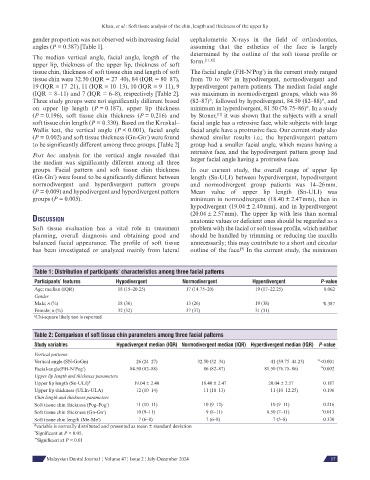
            gender proportion was not observed with increasing facial   cephalometric X-rays in the field of orthodontics,
            angles (P = 0.387) [Table 1].                       assuming that the esthetics of the face is largely
                                                                determined by the outline of the soft tissue profile or
            The median vertical angle, facial angle, length of the   form. [11,12]
            upper lip, thickness of the upper lip, thickness of soft
            tissue chin, thickness of soft tissue chin and length of soft   The facial angle (FH-NʹPogʹ) in the current study ranged
            tissue chin were 32.50 (IQR = 27–40), 84 (IQR = 80–87),   from 70 to 98° in hypodivergent, normodivergent and
            19 (IQR = 17–21), 11 (IQR = 10–13), 10 (IQR = 9–11), 9   hyperdivergent pattern patients. The median facial angle
            (IQR = 8–11) and 7 (IQR = 6–8), respectively [Table 2].     was maximum in normodivergent groups, which was 86
            Three study groups were not significantly different based   (82–87)°, followed by hypodivergent, 84.50 (82–88)°, and
            on upper lip length (P = 0.187), upper lip thickness   minimum in hyperdivergent, 81.50 (76.75–86)°. In a study
                                                                         [13]
            (P = 0.196), soft tissue chin thickness (P = 0.216)  and   by Stoner,  it was shown that the subjects with a small
            soft tissue chin length (P = 0.330). Based on the Kruskal–  facial angle has a retrosive face, while subjects with large
            Wallis test, the vertical angle (P < 0.001),  facial  angle   facial angle have a protrusive face. Our current study also
            (P = 0.002) and soft tissue thickness (Gn-Gnʹ) were found   showed similar results i.e.; the hyperdivergent pattern
            to be significantly different among three groups. [Table 2]  group had a smaller facial angle, which means having a
                                                                retrusive face, and the hypodivergent pattern group had
            Post hoc analysis for the vertical angle revealed that
            the  median  was  significantly  different  among  all  three   larger facial angle having a protrusive face.
            groups. Facial pattern and soft tissue  chin thickness   In our current study, the overall range of upper lip
            (Gn-Gnʹ) were found to be significantly different between   length (Sn-ULI) between hyperdivergent, hypodivergent
            normodivergent and  hyperdivergent  pattern  groups   and normodivergent group patients was 14–26 mm.
            (P = 0.009) and hypodivergent and hyperdivergent pattern   Mean value of upper lip length (Sn-ULI) was
            groups (P = 0.005).                                 minimum in normodivergent (18.40 ± 2.47 mm), then in
                                                                hypodivergent (19.04 ± 2.40 mm), and in hyperdivergent
                                                                (20.04 ± 2.57 mm). The upper lip with less than normal
            dIscussIon                                          anatomic values or deficient ones should be regarded as a
            Soft tissue evaluation has a vital role in treatment   problem with the facial or soft tissue profile, which neither
            planning, overall diagnosis and obtaining good and   should be handled by trimming or reducing the maxilla
            balanced facial appearance. The profile of soft tissue   unnecessarily; this may contribute to a short and circular
            has been investigated or analyzed mainly from lateral   outline of the face.  In the current study, the minimum
                                                                                 [9]

            Table 1: Distribution of participants’ characteristics among three facial patterns
            Participants’ features     Hypodivergent         Normodivergent          Hyperdivergent        P-value
            Age; median (IQR)           18 (15–20.25)          17 (14.75–20)         19 (17–22.25)          0.062
            Gender
            Male; n (%)                 18 (36)                13 (26)               19 (38)                ǂ 0.387
            Female; n (%)               32 (32)                37 (37)               31 (31)
            ǂ Chi-square likely test is reported

            Table 2: Comparison of soft tissue chin parameters among three facial patterns
            Study variables             Hypodivergent median (IQR) Normodivergent median (IQR) Hyperdivergent median (IQR)  P-value
            Vertical patterns
            Vertical angle (SN-GoGn)          26 (24–27)          32.50 (32–34)            41 (39.75–44.25)  ** <0.001
            Facial-angle(FH-NʹPogʹ)         84.50 (82–88)           86 (82–87)           81.50 (76.75–86)  ** 0.002
            Upper lip length and thickness parameters
            Upper lip length (Sn-ULI) #      19.04 ± 2.40           18.40 ± 2.47          20.04 ± 2.57      0.187
            Upper lip thickness (ULIn-ULA)    12 (10–14)            11 (10–13)             11 (10–12.25)    0.196
            Chin length and thickness parameters
            Soft tissue chin thickness (Pog–Pogʹ)  11 (10–11)       10 (9–12)              10 (9–11)        0.216
            Soft tissue chin thickness (Gn-Gnʹ)  10 (9–11)           9 (8–11)            8.50 (7–11)        * 0.013
            Soft tissue chin length (Me-Meʹ)   7 (6–8)               7 (6–8)               7 (5–8)          0.330
            # variable is normally distributed and presented as mean ± standard deviation
            * Significant at P < 0.05,
            ** Significant at P < 0.01


                    Malaysian Dental Journal  ¦ Volume 47 ¦ Issue 2 ¦ July-December 2024                      17

