


Page 28 - MDJ Volume 47 Number 2 ( Jul-Dec 2024)
P. 28
Fatima, et al.: Relationship of Cranial base growth with sagittal skeletal discrepancies
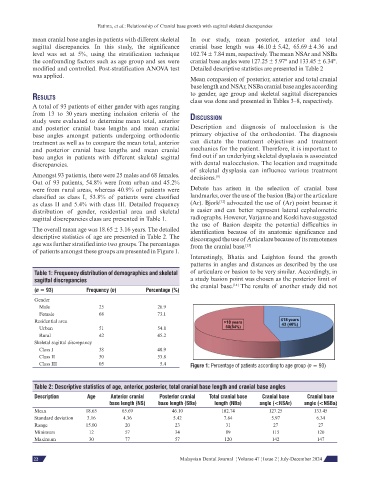
            mean cranial base angles in patients with different skeletal   In our study, mean posterior, anterior and total
            sagittal  discrepancies. In  this  study, the  significance   cranial base length was 46.10 ± 5.42, 65.69 ± 4.36 and
            level was set at 5%, using the stratification technique   102.74 ± 7.84 mm, respectively. The mean NSAr and NSBa
            the confounding factors such as age group and sex were   cranial base angles were 127.25 ± 5.97° and 133.45 ± 6.34°.
            modified and controlled. Post-stratification ANOVA test   Detailed descriptive statistics are presented in Table 2
            was applied.
                                                                Mean compassion of posterior, anterior and total cranial
                                                                base length and NSAr, NSBa cranial base angles according
                                                                to gender, age group  and skeletal sagittal discrepancies
            results
                                                                class was done and presented in Tables 3–8, respectively.
            A total of 93 patients of either gender with ages ranging
            from  13  to  30 years  meeting  inclusion  criteria of  the
            study were evaluated to determine mean total, anterior   dIscussIon
            and posterior cranial base lengths and mean cranial   Description and diagnosis of malocclusion is the
            base angles amongst patients undergoing orthodontic   primary objective of the orthodontist. The diagnosis
            treatment as well as to compare the mean total, anterior   can dictate the treatment objectives and treatment
            and posterior cranial base lengths and mean cranial   mechanics for the patient. Therefore, it is important to
            base angles in patients with different skeletal sagittal   find out if an underlying skeletal dysplasia is associated
            discrepancies.                                      with dental malocclusion. The location and magnitude
                                                                of skeletal dysplasia can influence various treatment
            Amongst 93 patients, there were 25 males and 68 females.   decisions. [9]
            Out of 93 patients, 54.8% were from urban and 45.2%
            were from rural areas, whereas 40.9% of patients were   Debate has arisen in the selection of cranial base
            classified as class I, 53.8% of patients were classified   landmarks, over the use of the basion (Ba) or the articulare
                                                                          [12]
            as class II and 5.4% with class III. Detailed frequency   (Ar). Bjork  advocated the use of (Ar) point because it
            distribution of gender, residential area and skeletal   is easier and can better represent lateral cephalometric
            sagittal discrepancies class are presented in Table 1.  radiographs. However, Varjanne and Koski have suggested
                                                                the use of Basion despite the potential difficulties in
            The overall mean age was 18.65 ± 3.16 years. The detailed   identification because of its anatomic significance and
            descriptive statistics of age are presented in Table 2. The   discouraged the use of Articulare because of its remoteness
            age was further stratified into two groups. The percentages   from the cranial base. [13]
            of patients amongst these groups are presented in Figure 1.
                                                                Interestingly, Bhatia and Leighton found the growth
                                                                patterns in angles and distances as described by the use
            Table 1: Frequency distribution of demographics and skeletal   of articulare or basion to be very similar. Accordingly, in
            sagittal discrepancies                              a study basion point was chosen as the posterior limit of
                                                                the cranial base.  The results of another study did not
                                                                              [14]
            (n = 93)          Frequency (n)      Percentage (%)
            Gender
                Male              25                 26.9
               Female             68                 73.1
            Residential area
                Urban             51                 54.8
                Rural             42                 45.2
            Skeletal sagittal discrepancy
                Class I           38                 40.9
                Class II          50                 53.8
                Class III         05                  5.4       Figure 1: Percentage of patients according to age group (n = 93)


            Table 2: Descriptive statistics of age, anterior, posterior, total cranial base length and cranial base angles
            Description       Age     Anterior cranial   Posterior cranial   Total cranial base   Cranial base   Cranial base
                                     base length (NS)  base length (SBa)  length (NBa)  angle (<NSAr)  angle (<NSBa)
            Mean             18.65       65.69            46.10           102.74          127.25         133.45
            Standard deviation  3.16      4.36            5.42             7.84            5.97           6.34
            Range            15.00        20               23               31             27             27
            Minimum           12          57               34               89             115            120
            Maximum           30          77               57              120             142            147


                                                        54   Malaysian Dental Journal  ¦ Volume 47 ¦ Issue 2 ¦ July-December 2024
            22

