


Page 16 - MDJ 2022 Jan-Jun, Volume 45 Number 1
P. 16
Husun / Md Dasor


            the  increased  diameter,  presumably  there  will  be  an   refers  to  the  whole  length  including  the  MI  head.  The
            increase of primary stability. According to a meta-analysis,   selection of the length should be based on the thickness of
            MIs with a diameter less than 1.3 mm have better success   the  cortical  bone  and  the  soft  tissue  at  the  area  of
                                                                      24
            rates than a MI with diameter 1.4–1.6 mm and 1.7–2.0 mm,   insertion.
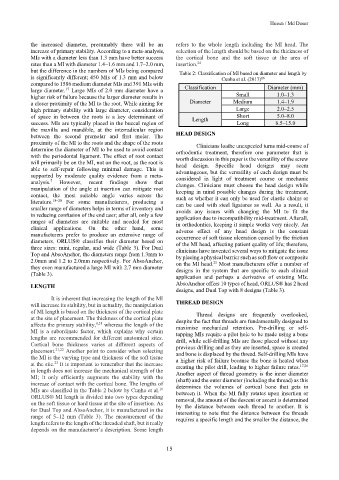
            but the difference in the numbers of MIs being compared   Table 2: Classification of MI based on diameter and length by
            is significantly different; 450 MIs of 1.3 mm and below            Cunha et al. (2017)
                                                                                             16
            compared to 1586 medium diameter MIs and 391 MIs with
                        17
            large diameter.  Large MIs of 2.0 mm diameter have a   Classification              Diameter (mm)
            higher risk of failure because the larger diameter results in           Small         1.0–1.3
            a closer proximity of the MI to the root. While aiming for   Diameter   Medium        1.4–1.9
            high primary stability with large diameter, consideration               Large         2.0–2.5
            of  space  in  between  the  roots  is  a  key  determinant  of   Length   Short      5.0–8.0
            success. MIs are typically placed in the buccal region of               Long          8.5–15.0
            the  maxilla  and  mandible,  at  the  interradicular  region
            between  the  second  premolar  and  first  molar.  The   HEAD DESIGN
            proximity of the MI to the roots and the shape of the roots      Clinicians loathe unexpected turns mid-course of
            determine the diameter of MI to be used to avoid contact   orthodontic  treatment,  therefore  one  parameter  that  is
            with the periodontal ligament. The effect of root contact   worth discussion in this paper is the versatility of the screw
            will primarily be on the MI, not on the root, as the root is   head  design.  Specific  head  designs  may  seem
            able  to  self-repair  following  minimal  damage.  This  is   advantageous, but the versatility of each design must be
            supported  by  moderate  quality  evidence  from  a  meta-  considered  in  light  of  treatment  course  or  mechanic
            analysis.   However,  recent  findings  show  that   changes.  Clinicians  must  choose  the  head  design  while
                   7
            manipulation  of  the  angle  at  insertion  can  mitigate  root   keeping  in  mind  possible  changes  during  the  treatment,
            contact,  the  most  suitable  angle  varies  across  the   such as whether it can only be used for elastic chains or
            literature. 18–20   For  some  manufacturers,  producing  a   can  be  used  with  steel  ligatures  as  well.  As  a  result,  it
            smaller range of diameters helps in terms of inventory and   avoids  any  issues  with  changing  the  MI  to  fit  the
            in reducing confusion of the end user; after all, only a few   application due to incompatibility mid-treatment. Afterall,
            ranges  of  diameters  are  suitable  and  needed  for  most   in orthodontics, keeping it simple works very nicely. An
            clinical applications.  On the other hand, some    adverse  effect  of  any  head  design  is  the  constant
            manufacturers  prefer  to  produce  an  extensive  range  of   occurrence of soft tissue ulceration caused by the friction
            diameters.  ORLUS®  classifies  their  diameter  based  on   of the MI head, affecting patient quality of life; therefore,
            three sizes: mini, regular, and wide (Table 3). For Dual   clinicians have invented several ways to mitigate the issue
            Top and AbsoAnchor, the diameters range from 1.3mm to   by placing a physical barrier such as soft flow or composite
            2.0mm and 1.2 to 2.0mm respectively. For AbsoAnchor,   on the MI head.  Most manufacturers offer a number of
                                                                            25
            they even manufactured a large MI with 2.7 mm diameter   designs  in  the  system  that  are  specific  to  each  clinical
            (Table 3).
                                                               application  and  perhaps  a  derivative  of  existing  MIs.
            LENGTH                                             AbsoAnchor offers 10 types of head, ORLUS® has 2 head
                                                               designs, and Dual Top with 8 designs (Table 3).
                   It is inherent that increasing the length of the MI
            will increase its stability, but in actuality, the manipulation   THREAD DESIGN
            of MI length is based on the thickness of the cortical plate      Thread  designs  are  frequently  overlooked,
            at the site of placement. The thickness of the cortical plate   despite the fact that threads are fundamentally designed to
            affects the primary stability, 8,21  whereas the length of the   maximise  mechanical  retention.  Pre-drilling  or  self-
            MI  is  a  subordinate  factor,  which  explains  why  certain   tapping MIs require a pilot hole to be made using a bone
            lengths  are  recommended  for  different  anatomical  sites.   drill, while self-drilling MIs are those placed without any
            Cortical  bone  thickness  varies  at  different  aspects  of   previous drilling and as they are inserted, space is created
            placement. 21,22  Another point to consider when selecting   and bone is displaced by the thread. Self-drilling MIs have
            the MI is the varying type and thickness of the soft tissue   a higher risk of failure because the bone is heated when
            at the site.  It is important to remember that the increase   creating the pilot drill, leading to higher failure rates. 17,26
                    23
            in length does not increase the mechanical strength of the   Another aspect of thread geometry is the inner diameter
            MI;  it  only  efficiently  augments  the  stability  with  the   (shaft) and the outer diameter (including the thread) as this
            increase of contact with the cortical bone. The lengths of   determines  the  volumes  of  cortical  bone  that  gets  in
                                                         16
            MIs are classified in the Table 2 below by Cunha et al.    between it. When the MI fully rotates upon insertion or
            ORLUS® MI length is divided into two types depending   removal, the amount of the descent or ascent is determined
            on the soft tissue or hard tissue at the site of insertion. As   by  the  distance  between  each  thread  to  another.  It  is
            for Dual Top and AbsoAnchor, it is manufactured in the   interesting to note that the distance between the threads
            range  of  5–12  mm  (Table  3).  The  measurement  of  the   requires a specific length and the smaller the distance, the
            length refers to the length of the threaded shaft, but it really
            depends on the manufacturer’s description. Some length


                                                           15

