


Page 40 - MDJ Volume 47 Number 2 ( Jul-Dec 2024)
P. 40
Mustafa, et al.: Management of the Impacted Tooth with Dilacerated Roots – A Surgical Challenge


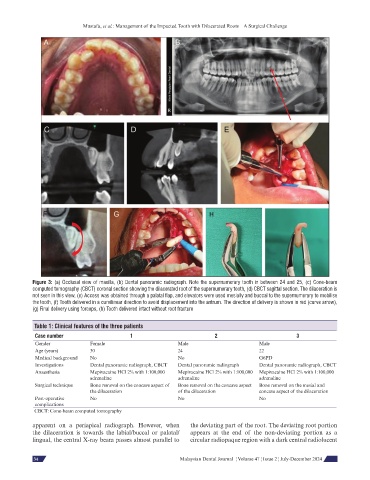
            Figure 3: (a) Occlusal view of maxilla, (b) Dental panoramic radiograph. Note the supernumerary tooth in between 24 and 25, (c) Cone-beam
            computed tomography (CBCT) coronal section showing the dilacerated root of the supernumerary tooth, (d) CBCT sagittal section. The dilaceration is
            not seen in this view, (e) Access was obtained through a palatal flap, and elevators were used mesially and buccal to the supernumerary to mobilise
            the tooth, (f) Tooth delivered in a curvilinear direction to avoid displacement into the antrum. The direction of delivery is shown in red (curve arrow),
            (g) Final delivery using forceps, (h) Tooth delivered intact without root fracture

            Table 1: Clinical features of the three patients

             Case number                    1                           2                          3
             Gender            Female                       Male                       Male
             Age (years)       30                           24                         22
             Medical background  No                         No                         G6PD
             Investigations    Dental panoramic radiograph, CBCT  Dental panoramic radiograph  Dental panoramic radiograph, CBCT
             Anaesthesia       Mepivacaine HCl 2% with 1:100,000   Mepivacaine HCl 2% with 1:100,000   Mepivacaine HCl 2% with 1:100,000
                               adrenaline                   adrenaline                 adrenaline
             Surgical technique  Bone removal on the concave aspect of   Bone removal on the concave aspect   Bone removal on the mesial and
                               the dilaceration             of the dilaceration        concave aspect of the dilaceration
             Post-operative    No                           No                         No
             complications
            CBCT: Cone-beam computed tomography

            apparent on a periapical radiograph. However, when   the deviating part of the root. The deviating root portion
            the dilaceration is towards the labial/buccal or palatal/  appears  at  the  end  of  the  non-deviating  portion  as  a
            lingual, the central X-ray beam passes almost parallel to   circular radiopaque region with a dark central radiolucent


                                                        66   Malaysian Dental Journal  ¦ Volume 47 ¦ Issue 2 ¦ July-December 2024
            34

