


Page 39 - MDJ Volume 47 Number 2 ( Jul-Dec 2024)
P. 39
Mustafa, et al.: Management of the Impacted Tooth with Dilacerated Roots – A Surgical Challenge


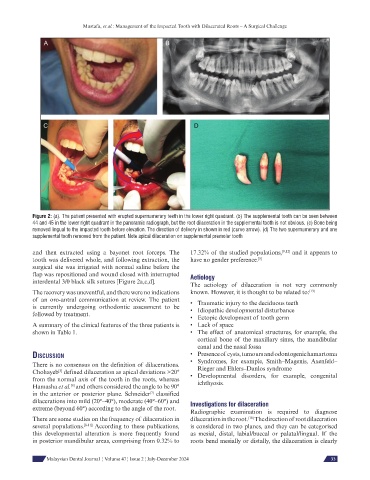
            Figure 2: (a). The patient presented with erupted supernumerary teeth in the lower right quadrant. (b) The supplemental tooth can be seen between
            44 and 45 in the lower right quadrant in the panoramic radiograph, but the root dilaceration in the supplemental tooth is not obvious. (c) Bone being
            removed lingual to the impacted tooth before elevation. The direction of delivery in shown in red (curve arrow). (d) The two supernumerary and one
            supplemental tooth removed from the patient. Note apical dilaceration on supplemental premolar tooth

            and then extracted using a bayonet root forceps. The   17.32% of the studied populations, [9,12]  and it appears to
            tooth was delivered whole, and following extraction, the   have no gender preference. [5]
            surgical site was irrigated with normal saline before the
            flap was repositioned and wound closed with interrupted   Aetiology
            interdental 3/0 black silk sutures [Figure 2a,c,d].
                                                                The  aetiology  of  dilaceration  is  not  very  commonly
            The recovery was uneventful, and there were no indications   known. However, it is thought to be related to: [13]
            of an oro-antral communication at review. The patient   • Traumatic injury to the deciduous teeth
            is currently undergoing orthodontic assessment to be   • Idiopathic developmental disturbance
            followed by treatment.
                                                                • Ectopic development of tooth germ
            A summary of the clinical features of the three patients is   • Lack of space
            shown in Table 1.                                   • The effect of anatomical structures, for example, the
                                                                  cortical bone of the maxillary sinus, the mandibular
                                                                  canal and the nasal fossa
            dIscussIon                                          •  Presence of cysts, tumours and odontogenic hamartoma
            There is no consensus on the definition of dilacerations.   • Syndromes, for example, Smith–Magenis, Axenfeld–
                                                                  Rieger and Ehlers–Danlos syndrome
                    [5]
            Chohayeb  defined dilaceration as apical deviations >20°   • Developmental disorders, for example, congenital
            from the normal axis of the tooth in the roots, whereas   ichthyosis.
                        [6]
            Hamasha et al.  and others considered the angle to be 90°
                                                   [7]
            in the anterior or posterior plane. Schneider  classified
            dilacerations into mild (20°–40°), moderate (40°–60°) and   Investigations for dilaceration
            extreme (beyond 60°) according to the angle of the root.
                                                                Radiographic  examination  is  required  to  diagnose
            There are some studies on the frequency of dilaceration in   dilaceration in the root.  The direction of root dilaceration
                                                                                   [10]
            several populations. [8-11]  According to these publications,   is considered in two planes, and they can be categorised
            this developmental alteration is more frequently found   as mesial, distal, labial/buccal or palatal/lingual. If the
            in posterior mandibular areas, comprising from 0.32% to   roots bend mesially or distally, the dilaceration is clearly


                    Malaysian Dental Journal  ¦ Volume 47 ¦ Issue 2 ¦ July-December 2024                      33

