


Page 44 - MDJ Volume 47 Number 2 ( Jul-Dec 2024)
P. 44
Sharma, et al.: Gingivectomy via electrosurgery


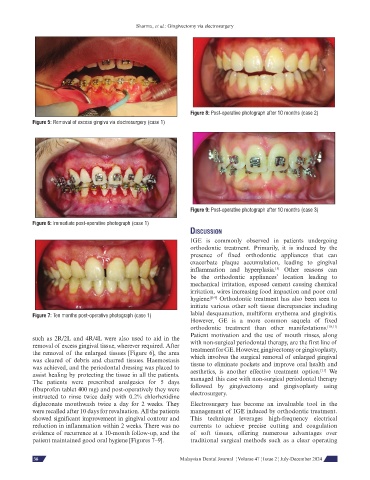
                                                                Figure 8: Post-operative photograph after 10 months (case 2)
            Figure 5: Removal of excess gingiva via electrosurgery (case 1)


                                                                Figure 9: Post-operative photograph after 10 months (case 3)
            Figure 6: Immediate post-operative photograph (case 1)
                                                                dIscussIon
                                                                IGE is commonly observed in patients undergoing
                                                                orthodontic  treatment. Primarily, it is induced  by the
                                                                presence of fixed orthodontic appliances that can
                                                                exacerbate plaque accumulation, leading to gingival
                                                                inflammation and hyperplasia.  Other reasons can
                                                                                            [5]
                                                                be the orthodontic appliances’ location leading to
                                                                mechanical irritation, exposed cement causing chemical
                                                                irritation, wires increasing food impaction and poor oral
                                                                hygiene. [6-9]  Orthodontic treatment has also been seen to
                                                                initiate  various  other  soft tissue  discrepancies  including
            Figure 7: Ten months post-operative photograph (case 1)  labial desquamation, multiform erythema and gingivitis.
                                                                However,  GE  is  a  more  common  sequela  of  fixed
                                                                orthodontic treatment than other manifestations. [10,11]
                                                                Patient motivation and the use of mouth rinses, along
            such  as 2R/2L  and 4R/4L  were also  used  to aid  in the   with non-surgical periodontal therapy, are the first line of
            removal of excess gingival tissue, wherever required. After   treatment for GE. However, gingivectomy or gingivoplasty,
            the removal of the enlarged tissues [Figure 6], the area   which involves the surgical removal of enlarged gingival
            was cleared of debris and charred tissues. Haemostasis   tissue to eliminate pockets and improve oral health and
            was achieved, and the periodontal dressing was placed to   aesthetics, is another effective treatment option.  We
                                                                                                           [11]
            assist healing by protecting the tissue in all the patients.   managed this case with non-surgical periodontal therapy
            The  patients  were  prescribed  analgesics  for  5  days   followed by gingivectomy and gingivoplasty using
            (Ibuprofen tablet 400 mg) and post-operatively they were   electrosurgery.
            instructed  to  rinse  twice  daily  with  0.2%  chlorhexidine
            digluconate mouthwash twice a day for 2 weeks. They   Electrosurgery has become an invaluable tool in the
            were recalled after 10 days for revaluation. All the patients   management of IGE induced by orthodontic treatment.
            showed significant improvement in gingival contour and   This technique leverages high-frequency electrical
            reduction in inflammation within 2 weeks. There was no   currents to achieve precise cutting and coagulation
            evidence of recurrence at a 10-month follow-up, and the   of soft tissues, offering numerous advantages over
            patient maintained good oral hygiene [Figures 7–9].  traditional surgical methods such as a clear operating


                                                        70   Malaysian Dental Journal  ¦ Volume 47 ¦ Issue 2 ¦ July-December 2024
            38

