


Page 11 - MDJ 2022 Jan-Jun, Volume 45 Number 1
P. 11
Transmigration of Mandibular Canine in a Patient with Hypoplastic Mandible: A case report


                                                               caused  by  lasting  root  formation,  and  a  pericoronal
                                                               osteolytic area caused by widening of the follicular space.
                                                               In our case, the transmigration appears to be associated
                                                                                                             1
                                                               with  crowding  secondary  to  mandibular  hypoplasia.
                                                               Although the mandible was hypoplastic and therefore of
                                                               slightly reduced size, the canine was able to transmigrate
                                                               without hindrance and did not cause resorption of the roots
                                                               of the lower anterior and lower right premolar teeth. In our
                                                               patient, the mandibular hypoplasia affected the condylar
                                                               region more than the body. This meant that most of the
                                                               anterior  mandibular  height  was  retained,  allowing
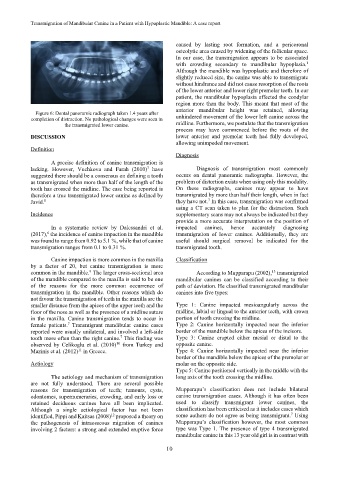
             Figure 6: Dental panoramic radiograph taken 1.4 years after
            completion of distraction. No pathological changes were seen in   unhindered movement of the lower left canine across the
                        the transmigrated lower canine.        midline. Furthermore, we postulate that the transmigration
                                                               process  may  have  commenced  before  the  roots  of  the
            DISCUSSION                                         lower  anterior  and  premolar  teeth  had  fully  developed,
                                                               allowing unimpeded movement.
            Definition
                                                               Diagnosis
                   A precise definition of canine transmigration is
                                                     7
            lacking.  However,  Vuchkova  and  Farah  (2010)  have      Diagnosis  of  transmigration  most  commonly
            suggested there should be a consensus on defining a tooth   occurs  on  dental  panoramic  radiographs.  However,  the
            as transmigrated when more than half of the length of the   problem of distortion exists when using only this modality.
            tooth has crossed the midline. The case being reported is   On  these  radiographs,  canines  may  appear  to  have
            therefore a true transmigrated lower canine as defined by   transmigrated by more than half their length, when in fact
                                                                          7
            Javid.                                             they have not.  In this case, transmigration was confirmed
                 8
                                                               using  a  CT  scan  taken  to  plan  for  the  distraction.  Such
            Incidence                                          supplementary scans may not always be indicated but they
                                                               provide a more accurate interpretation on the position of
                   In  a  systematic  review  by  Dalessandri  et  al.   impacted   canines,   hence   accurately   diagnosing
            (2017),  the incidence of canine impaction in the mandible   transmigration  of  lower  canines.  Additionally,  they  are
                  6
            was found to range from 0.92 to 5.1 %, while that of canine   useful  should  surgical  removal  be  indicated  for  the
            transmigration ranges from 0.1 to 0.31 %.          transmigrated tooth.
                   Canine impaction is more common in the maxilla   Classification
            by  a  factor  of  20,  but  canine  transmigration  is  more
                                9
            common in the mandible.  The larger cross-sectional area      According to Mupparapu (2002),  transmigrated
                                                                                                13
            of the mandible compared to the maxilla is said to be one   mandibular  canines  can  be  classified  according  to  their
            of  the  reasons  for  the  more  common  occurrence  of   path of deviation. He classified transmigrated mandibular
            transmigration in the mandible. Other reasons which do   canines into five types:
            not favour the transmigration of teeth in the maxilla are the
            smaller distance from the apices of the upper teeth and the   Type  1:  Canine  impacted  mesioangularly  across  the
            floor of the nose as well as the presence of a midline suture   midline, labial or lingual to the anterior teeth, with crown
            in  the  maxilla.  Canine  transmigration  tends  to  occur  in   portion of tooth crossing the midline.
                         7
            female  patients.   Transmigrant  mandibular  canine  cases   Type  2:  Canine  horizontally  impacted  near  the  inferior
            reported were usually unilateral, and involved a left-side   border of the mandible below the apices of the incisors.
            tooth more often than the right canine.  This finding was   Type  3:  Canine  erupted  either  mesial  or  distal  to  the
                                           7
            observed  by  Celikoglu  et  al.  (2010)   from  Turkey  and   opposite canine.
                                          10
            Mazinis et al. (2012)  in Greece.                  Type  4:  Canine  horizontally  impacted  near  the  inferior
                            11
                                                               border of the mandible below the apices of the premolar or
            Aetiology                                          molar on the opposite side.
                                                               Type 5: Canine positioned vertically in the middle with the
                   The aetiology and mechanism of transmigration   long axis of the tooth crossing the midline.
            are  not  fully  understood.  There  are  several  possible
            reasons  for  transmigration  of  teeth;  tumours,  cysts,   Mupparapu’s  classification  does  not  include  bilateral
            odontomes, supernumeraries, crowding, and early loss or   canine  transmigration  cases.  Although  it  has  often  been
            retained  deciduous  canines  have  all  been  implicated.   used  to  classify  transmigrant  lower  canines,  the
            Although  a  single  aetiological  factor  has  not  been   classification has been criticised as it includes cases which
                                                                                                       7
                                        12
            identified, Pippi and Kaitsas (2008)  proposed a theory on   some authors do not agree as being transmigrant.  Using
            the  pathogenesis  of  intraosseous  migration  of  canines   Mupparapu’s  classification  however,  the  most  common
            involving 2 factors: a strong and extended eruptive force   type was Type 1. The presence of type 4 transmigrated
                                                               mandibular canine in this 13 year old girl is in contrast with

                                                           10

