


Page 15 - MDJ 2022 Jan-Jun, Volume 45 Number 1
P. 15
Orthodontic Mini Implant: Malaysian perspective


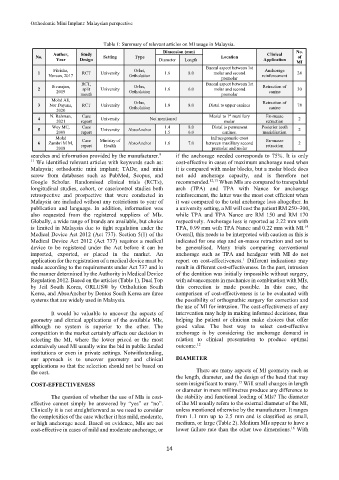
                                     Table 1: Summary of relevant articles on MI usage in Malaysia.
                                                          Dimension (mm)                                 No.
                    Author,   Study                                                            Clinical
              No.                    Setting    Type                           Location                   of
                     Year    Design                      Diameter   Length                    Application
                                                                                                         MI
                                                                         Buccal aspect between 1st
                    Fitrisha,                   Orlus,                                        Anchorage
              1               RCT   University             1.6     8.0      molar and second             24
                  Noreen, 2017                Ortholution                                    reinforcement
                                                                               premolar
                              RCT,                                       Buccal aspect between 1st
                   Sivarajan,                   Orlus,                                       Retraction of
              2               split   University           1.6     6.0      molar and second             30
                     2019                     Ortholution                                      canine
                             mouth                                             premolar
                   Mohd Ali,                    Orlus,                                       Retraction of
              3   Nor Dayana,   RCT   University           1.8     8.0    Distal to upper canines        78
                     2020                     Ortholution                                      canine
                                                                                  st
                   N. Rahman,   Case                                       Mesial to 1  maxillary   En-masse
              4                     University        Not mentioned                                       2
                     2021    report                                             molar         retraction
                   Wey MC,    Case                         1.4     8.0     Distal to permanent   Posterior teeth
              5                     University   AbsoAnchor                                               2
                     2008    report                        1.5     6.0         canines.      mesialisation
                     Mohd                                                  Infrazygomatic crest
                              Case
              6   Zambri M M,   report   Ministry of   AbsoAnchor   1.6   7.0   between maxillary second   En-masse   2
                                                                                              retraction
                                      Health
                     2018                                                  premolar and molar
            searches and information provided by the manufacturer. 9–  if  the  anchorage  needed  corresponds  to  75%.  It  is  only
            11  We identified relevant articles with keywords such as:   cost-effective in cases of maximum anchorage need when
            Malaysia;  orthodontic  mini  implant;  TADs;  and  mini   it is compared with molar blocks, but a molar block does
            screw  from  databases  such  as  PubMed,  Scopus,  and   not  add  anchorage  capacity,  and  is  therefore  not
            Google  Scholar.  Randomised  clinical  trials  (RCTs),   recommended. 12,13  When MIs are compared to transpalatal
            longitudinal studies, cohort, or case/control studies both   arch  (TPA)  and  TPA  with  Nance  for  anchorage
            retrospective  and  prospective  that  were  conducted  in   reinforcement, the latter was the most cost efficient when
            Malaysia are included without any restrictions to year of   it was compared to the total anchorage loss altogether. In
            publication  and  language.  In  addition,  information  was   a university setting, a MI will cost the patient RM 250–300,
            also  requested  from  the  registered  suppliers  of  MIs.   while  TPA  and  TPA  Nance  are  RM  150  and  RM  170
            Globally, a wide range of brands are available, but choice   respectively. Anchorage loss is reported as 2.22 mm with
            is  limited  in  Malaysia  due  to  tight  regulation  under  the   TPA, 0.99 mm with TPA Nance and 0.22 mm with MI.
                                                                                                            14
            Medical Device Act 2012 (Act 737). Section 5(1) of the   Overall, this needs to be interpreted with caution as this is
            Medical  Device  Act  2012  (Act  737)  requires  a  medical   indicated for one step and en-masse retraction and not to
            device  to  be  registered  under  the  Act  before  it  can  be   be  generalised.  Many  trials  comparing  conventional
            imported,  exported,  or  placed  in  the  market.  An   anchorage  such  as  TPA  and  headgear  with  MI  do  not
            application for the registration of a medical device must be   report  on  cost-effectiveness.   Different  indications  may
                                                                                      1
            made according to the requirements under Act 737 and in   result in different cost-effectiveness. In the past, intrusion
            the manner determined by the Authority in Medical Device   of the dentition was initially impossible without surgery,
            Regulation 2012. Based on the articles (Table 1), Dual Top   with advancements in mechanics in combination with MIs,
            by  Jeil  South  Korea,  ORLUS®  by  Ortholution  South   this  correction  is  made  possible.  In  this  case,  the
            Korea, and AbsoAnchor by Dentos South Korea are three   comparison of cost-effectiveness is to be evaluated with
            systems that are widely used in Malaysia.          the possibility of orthognathic surgery for correction and
                                                               the use of MI for intrusion. The cost-effectiveness of any
                   It  would  be  valuable  to  uncover  the  aspects  of   intervention may help in making informed decisions, thus
            geometry and clinical applications of the available MIs,   helping  the  patient  or  clinician  make  choices  that  offer
            although  no  system  is  superior  to  the  other.  The   good  value.  The  best  way  to  select  cost-effective
            competition in the market certainly affects our decision in   anchorage  is  by  considering  the  anchorage  demand  in
            selecting  the  MI,  where  the  lower  priced  or  the  most   relation  to  clinical  presentation  to  produce  optimal
                                                                      12
            extensively used MI usually wins the bid in public funded   outcome.
            institutions or even in private settings. Notwithstanding,
            our  approach  is  to  uncover  geometry  and  clinical   DIAMETER
            applications so that the selection should not be based on
            the cost.                                                 There are many aspects of MI geometry such as
                                                               the length, diameter, and the design of the head that may
                                                                                     15
            COST-EFFECTIVENESS                                 seem insignificant to many.  Will small changes in length
                                                               or diameter in mere millimetres produce any difference to
                   The question of whether the use of MIs is cost-  the stability and functional loading of MIs? The diameter
            effective  cannot  simply  be  answered  by  “yes”  or  “no”.   of the MI usually refers to the external diameter of the MI,
            Clinically it is not straightforward as we need to consider   unless mentioned otherwise by the manufacturer. It ranges
            the complexities of the case whether it has mild, moderate,   from 1.1 mm  up  to 2.5 mm  and  is classified as  small,
            or high anchorage need. Based on evidence, MIs are not   medium, or large (Table 2). Medium MIs appear to have a
                                                                                                       16
            cost-effective in cases of mild and moderate anchorage, or   lower failure rate than the other two dimensions.  With


                                                           14

