


Page 34 - MDJ Volume 47 Number 2 ( Jul-Dec 2024)
P. 34
Dhanrajani: Odontogenic keratocyst
            number of peripheral OKCs have been reported. [1,2]    suggesting the term ‘Odontogenic Keratocyst’. Since
            The term ‘Primordial cyst’ was first mentioned in 1945   then, OKC has been the most frequently researched cyst
            by Robinson because the cysts were believed to have   due to its high recurrence rate and aggressive clinical
            primordial origin.  In 1956, Philipsen and Reichart    behaviour and associated with the nevoid basal cell
                            [1]
                                                           [2]
            published a paper in Danish with an English summary   carcinoma syndrome. [8,9]
                                                                In 2005 the WHO reclassified OKC as a neoplasm
                                                                and recommended  keratocystic  odontogenic tumour
                                                                (KCOT) as the appropriate designation. In justifying
                                                                the  reclassification,  they  stressed  ‘aggressive’  behaviour,
                                                                recurrence, the occasional occurrence of a ‘solid’ variant
                                                                and mutations in the protein patched homolog 1 (PTCH1)
                                                                gene.
                                                                The fourth edition of the WHO Classification of Head
                                                                and Neck Tumours, published in January 2017, has
                                                                reclassified odontogenic keratocystic tumour as OKC. [3-5]
                                                                OKCs are now considered benign cysts of odontogenic
                                                                origin. This has raised a debate between the groups who
                                                                considered OKCs as KCOT and vice versa. [2,3,5,6]
                                                                The  fifth  edition  of  the  WHO classification  of head
                                                                and neck tumours, published in January 2022, OKC
                                                                continues in the cyst classification and has the longest
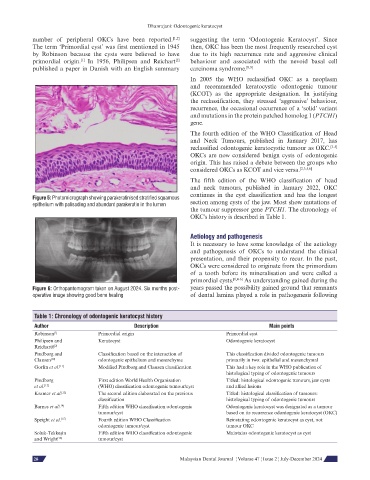
            Figure 5: Photomicrograph showing parakeratinised stratified squamous
            epithelium with palisading and abundant parakeratin in the lumen  section among cysts of the jaw. Most show mutations of
                                                                the tumour suppressor gene PTCH1. The chronology of
                                                                OKC's history is described in Table 1.


                                                                Aetiology and pathogenesis
                                                                It is necessary to have some knowledge of the aetiology
                                                                and  pathogenesis  of  OKCs  to  understand  the  clinical
                                                                presentation, and their propensity to recur. In the past,
                                                                OKCs were considered to originate from the primordium
                                                                of a tooth before its mineralisation and were called a
                                                                primordial cysts. [1,4-6]  As understanding gained during the
            Figure 6: Orthopantomogram taken on August 2024. Six months post-  years passed the possibility gained ground that remnants
            operative image showing good bone healing           of dental lamina played a role in pathogenesis following


            Table 1: Chronology of odontogenic keratocyst history
            Author                           Description                                  Main points
            Robinson [1]          Primordial origin                         Primordial cyst
            Philipsen and         Keratocyst                                Odontogenic keratocyst
            Reichart6 [2]
            Pindborg and          Classification based on the interaction of   This classification divided odontogenic tumours
            Clausen [10]          odontogenic epithelium and mesenchyme     primarily in two: epithelial and mesenchymal
            Gorlin et al. [11]    Modified Pindborg and Clausen classification  This had a key role in the WHO publication of
                                                                            histological typing of odontogenic tumours
            Pindborg              First edition World Health Organisation   Titled: histological odontogenic tumours, jaw cysts
            et al.  [12]          (WHO) classification odontogenic tumour/cyst  and allied lesions
            Kramer et al. [13]    The second edition elaborated on the previous   Titled: histological classification of tumours:
                                  classification                            histological typing of odontogenic tumours
            Barnes et al. [14]    Fifth edition WHO classification odontogenic   Odontogenic keratocyst was designated as a tumour
                                  tumour/cyst                               based on its recurrence odontogenic keratocyst (OKC)
            Speight et al. [15]   Fourth edition WHO Classification         Reinstating odontogenic keratocyst as cyst, not
                                  odontogenic tumour/cyst                   tumour OKC
            Soluk-Tekkeşin        Fifth edition WHO classification odontogenic   Maintains odontogenic keratocyst as cyst
            and Wright [16]       tumour/cyst


                                                        60   Malaysian Dental Journal  ¦ Volume 47 ¦ Issue 2 ¦ July-December 2024
            28

