


Page 28 - MDA SCATE 2023 Programme Book
P. 28
SPEAKER PROFILE (DAY 3)


                                Workshop :  Smart Guide to Smarter Implant Placement

                                Digital dentistry has evolved tremendously over the past decade, especially in Implant
                                dentistry. It’s a convincing fact that using digital guided implant surgical guide has resulted
                                in a predictable and successful outcome. But that planning protocol will incur a huge cost
                                and it’s always a drawback for the beginners.  What if, there’s another method to place
                                implants using a simple procedure for both the beginner and experienced implantologist,
                                and able to achieve almost 90% success and predictable outcomes like the digital solution?
                                The  special  guide  will guide  implant  placement  to  an  optimum surgical solution  and  to
                                achieve success, every time and at a very affordable cost only. You should try it; simple, fast
                                & smarter.
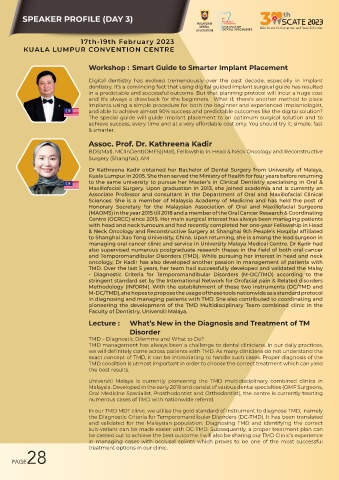
                                Assoc. Prof. Dr. Kathreena Kadir
                                BDS(Mal), MClinDent(OMFS)(Mal), Fellowship in Head & Neck Oncology and Reconstructive
                                Surgery (Shanghai), AM
                                Dr Kathreena Kadir obtained her Bachelor of Dental Surgery from University of Malaya,
                                Kuala Lumpur in 2005. She then served the Ministry of Health for four years before returning
                                to the same university to pursue her Master’s in Clinical Dentistry specialising in Oral &
                                Maxillofacial Surgery. Upon graduation in 2013, she joined academia and is currently an
                                Associate Professor  and consultant in the Department of Oral and Maxillofacial Clinical
                                Sciences. She is a member of Malaysia Academy of Medicine and has held the post of
                                Honorary Secretary for the Malaysian Association of Oral and Maxillofacial Surgeons
                                (MAOMS) in the year 2015 till 2018 and a member of the Oral Cancer Research & Coordinating
                                Centre (OCRCC) since 2015. Her main surgical interest has always been managing patients
                                with head and neck tumours and had recently completed her one-year Fellowship in Head
                                & Neck Oncology and Reconstructive Surgery at Shanghai 9th People’s Hospital affiliated
                                to Shanghai Jiao Tong University, China. Upon returning, she is among the lead surgeon in
                                managing oral cancer clinic and service in University Malaya Medical Centre. Dr Kadir had
                                also supervised numerous postgraduate research theses in the field of both oral cancer
                                and Temporomandibular Disorders (TMD). While pursuing her interest in head and neck
                                oncology, Dr Kadir has also developed another passion in management of patients with
                                TMD. Over the last 5 years, her team had successfully developed and validated the Malay
                                - Diagnostic Criteria for Temporomandibular Disorders (M-DC/TMD) according to the
                                stringent standard set by the International Network for Orofacial pain & Related disorders
                                Methodology (INfORM). With the establishment of these two instruments (DC/TMD and
                                M-DC/TMD), she hopes to propose the usage of these tools nationwide as a standard protocol
                                in diagnosing and managing patients with TMD. She also contributed to coordinating and
                                pioneering the development of the TMD Multidisciplinary Team combined clinic in the
                                Faculty of Dentistry, Universiti Malaya.
                                Lecture :     What’s New in the Diagnosis and Treatment of TM
                                               Disorder
                                TMD – Diagnostic Dilemma and What to Do?
                                TMD management has always been a challenge to dental clinicians. In our daily practices,
                                we will definitely come across patients with TMD. As many clinicians do not understand the
                                exact concept of TMD, it can be intimidating to handle such cases. Proper diagnosis of the
                                TMD condition is utmost important in order to choose the correct treatment which can yield
                                the best results.

                                Universiti Malaya is currently pioneering the TMD multidisciplinary combined clinics in
                                Malaysia. Developed in the early 2019 and consist of various dental specialties (OMF Surgeons,
                                Oral Medicine Specialist, Prosthodontist and Orthodontist), the centre is currently treating
                                numerous cases of TMD with nationwide referral.
                                In our TMD MDT clinic, we utilise the gold standard of instrument to diagnose TMD,  namely
                                the Diagnostic Criteria for Temporomandibular Disorders (DC-TMD). It has been translated
                                and validated for the Malaysian population. Diagnosing TMD and identifying the correct
                                sub-variant can be made easier with DC-TMD. Subsequently, a proper treatment plan can
                                be carried out to achieve the best outcome. I will also be sharing our TMD Clinic’s experience
                                in managing cases with occlusal splints which proves to be one of the most successful
                                treatment options in our clinic.
     PAGE28

