


Page 19 - MDA SCATE 2024 Programme Book
P. 19
DAY 2

                                                                 CONFERENCE SPEAKER


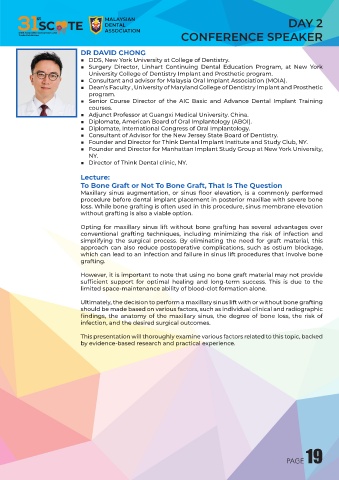
                             DR DAVID CHONG
                             ■   DDS, New York University at College of Dentistry.
                             ■   Surgery  Director,  Linhart  Continuing  Dental  Education  Program,  at  New  York
                                University College of Dentistry Implant and Prosthetic program.
                             ■   Consultant and advisor for Malaysia Oral Implant Association (MOIA).
                             ■   Dean’s Faculty , University of Maryland College of Dentistry Implant and Prosthetic
                                program.
                             ■   Senior  Course  Director  of  the  AIC  Basic  and  Advance  Dental  Implant  Training
                                courses.
                             ■   Adjunct Professor at Guangxi Medical University. China.
                             ■   Diplomate, American Board of Oral Implantology (ABOI).
                             ■  Diplomate, International Congress of Oral Implantology.
                             ■   Consultant of Advisor for the New Jersey State Board of Dentistry.
                             ■   Founder and Director for Think Dental Implant Institute and Study Club, NY.
                             ■   Founder and Director for Manhattan Implant Study Group at New York University,
                                NY.
                             ■   Director of Think Dental clinic, NY.

                             Lecture:
                             To Bone Graft or Not To Bone Graft, That Is The Question
                             Maxillary  sinus  augmentation,  or  sinus  floor  elevation,  is  a  commonly  performed
                             procedure before dental implant placement in posterior maxillae with severe bone
                             loss. While bone grafting is often used in this procedure, sinus membrane elevation
                             without grafting is also a viable option.

                             Opting  for  maxillary  sinus  lift  without  bone  grafting  has  several  advantages  over
                             conventional  grafting  techniques,  including  minimizing  the  risk  of  infection  and
                             simplifying  the  surgical  process.  By  eliminating  the  need  for  graft  material,  this
                             approach  can  also  reduce  postoperative  complications,  such  as  ostium  blockage,
                             which can lead to an infection and failure in sinus lift procedures that involve bone
                             grafting.

                             However, it is important to note that using no bone graft material may not provide
                             sufficient  support  for  optimal  healing  and  long-term  success.  This  is  due  to  the
                             limited space-maintenance ability of blood-clot formation alone.

                             Ultimately, the decision to perform a maxillary sinus lift with or without bone grafting
                             should be made based on various factors, such as individual clinical and radiographic
                             findings,  the  anatomy  of  the  maxillary  sinus,  the  degree  of  bone  loss,  the  risk  of
                             infection, and the desired surgical outcomes.

                             This presentation will thoroughly examine various factors related to this topic, backed
                             by evidence-based research and practical experience.


                                                                                                      PAGE 19

