


Page 24 - MDA SCATE 2024 Programme Book
P. 24
DAY 2

                                                                 CONFERENCE SPEAKER


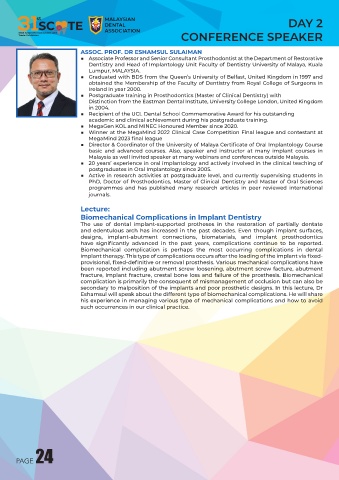
                             ASSOC. PROF. DR ESHAMSUL SULAIMAN
                             ■   Associate Professor and Senior Consultant Prosthodontist at the Department of Restorative
                                Dentistry and Head of Implantology Unit Faculty of Dentistry University of Malaya, Kuala
                                Lumpur, MALAYSIA.
                             ■   Graduated with BDS from the Queen’s University of Belfast, United Kingdom in 1997 and
                                obtained the Membership of the Faculty of Dentistry from Royal College of Surgeons in
                                Ireland in year 2000.
                             ■   Postgraduate training in Prosthodontics (Master of Clinical Dentistry) with
                                Distinction from the Eastman Dental Institute, University College London, United Kingdom
                                in 2004.
                             ■   Recipient of the UCL Dental School Commemorative Award for his outstanding
                                academic and clinical achievement during his postgraduate training.
                             ■   MegaGen KOL and MINEC Honoured Member since 2020.
                             ■   Winner at the MegaMind 2022 Clinical Case Competition Final league and contestant at
                                MegaMind 2023 final league
                             ■   Director & Coordinator of the University of Malaya Certificate of Oral Implantology Course
                                basic  and  advanced  courses.  Also,  speaker  and  instructor  at  many  implant  courses  in
                                Malaysia as well invited speaker at many webinars and conferences outside Malaysia.
                             ■   20 years’ experience in oral implantology and actively involved in the clinical teaching of
                                postgraduates in Oral Implantology since 2005.
                             ■   Active in research activities at postgraduate level, and currently supervising students in
                                PhD, Doctor of Prosthodontics, Master of Clinical Dentistry and Master of Oral Sciences
                                programmes  and  has  published  many  research  articles  in  peer  reviewed  international
                                journals.

                             Lecture:
                             Biomechanical Complications in Implant Dentistry
                             The  use  of  dental  implant-supported  protheses  in  the  restoration  of  partially  dentate
                             and edentulous arch has increased in the past decades. Even though implant surfaces,
                             designs,  implant-abutment  connections,  biomaterials,  and  implant  prosthodontics
                             have  significantly  advanced  in  the  past  years,  complications  continue  to  be  reported.
                             Biomechanical  complication  is  perhaps  the  most  occurring  complications  in  dental
                             implant therapy. This type of complications occurs after the loading of the implant via fixed-
                             provisional, fixed-definitive or removal prosthesis. Various mechanical complications have
                             been reported including abutment screw loosening, abutment screw facture, abutment
                             fracture, implant fracture, crestal bone loss and failure of the prosthesis. Biomechanical
                             complication is primarily the consequent of mismanagement of occlusion but can also be
                             secondary to malposition of the implants and poor prosthetic designs. In this lecture, Dr
                             Eshamsul will speak about the different type of biomechanical complications. He will share
                             his experience in managing various type of mechanical complications and how to avoid
                             such occurrences in our clinical practice.


       PAGE 24

