


Page 33 - MDJ Volume 47 Number 2 ( Jul-Dec 2024)
P. 33
Dhanrajani: Odontogenic keratocyst
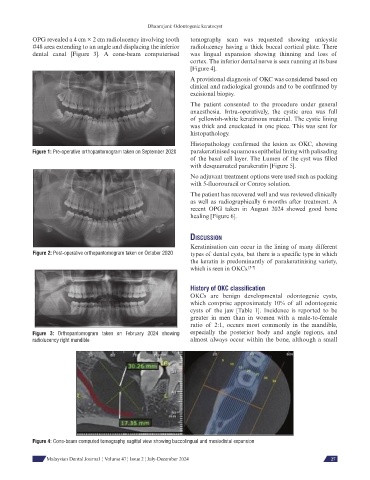
            OPG revealed a 4 cm × 2 cm radiolucency involving tooth   tomography  scan  was  requested  showing  unicystic
            #48 area extending to an angle and displacing the inferior   radiolucency having a thick buccal cortical plate. There
            dental canal [Figure 3]. A cone-beam computerised   was lingual expansion showing thinning and loss of
                                                                cortex. The inferior dental nerve is seen running at its base
                                                                [Figure 4].

                                                                A provisional diagnosis of OKC was considered based on
                                                                clinical and radiological grounds and to be confirmed by
                                                                excisional biopsy.
                                                                The patient consented to the procedure under general
                                                                anaesthesia.  Intra-operatively, the  cystic  area  was  full
                                                                of yellowish-white keratinous material. The cystic lining
                                                                was thick and enucleated in one piece. This was sent for
                                                                histopathology.
                                                                Histopathology confirmed the lesion as OKC, showing
            Figure 1: Pre-operative orthopantomogram taken on September 2020  parakeratinised squamous epithelial lining with palisading
                                                                of the basal cell layer. The Lumen of the cyst was filled
                                                                with desquamated parakeratin [Figure 5].
                                                                No adjuvant treatment options were used such as packing
                                                                with 5-fluorouracil or Conroy solution.
                                                                The patient has recovered well and was reviewed clinically
                                                                as  well  as  radiographically  6 months  after  treatment.  A
                                                                recent  OPG  taken  in  August  2024 showed  good  bone
                                                                healing [Figure 6].


                                                                dIscussIon
                                                                Keratinisation can occur in the lining of many different
            Figure 2: Post-operative orthopantomogram taken on October 2020  types of dental cysts, but there is a specific type in which
                                                                the keratin is predominantly of parakeratinising variety,
                                                                which is seen in OKCs. [5-7]


                                                                History of OKC classification
                                                                OKCs  are  benign  developmental  odontogenic  cysts,
                                                                which comprise approximately 10% of all odontogenic
                                                                cysts of the jaw [Table 1]. Incidence is reported to be
                                                                greater in men than in women with a male-to-female
                                                                ratio of 2:1, occurs most commonly in the mandible,
            Figure 3: Orthopantomogram taken on February 2024 showing   especially the posterior body and angle regions, and
            radiolucency right mandible                         almost always occur within the bone, although a small


            Figure 4: Cone-beam computed tomography sagittal view showing buccolingual and mesiodistal expansion


                    Malaysian Dental Journal  ¦ Volume 47 ¦ Issue 2 ¦ July-December 2024                      27

