


Page 29 - MDJ Volume 47 Number 2 ( Jul-Dec 2024)
P. 29
Fatima, et al.: Relationship of Cranial base growth with sagittal skeletal discrepancies

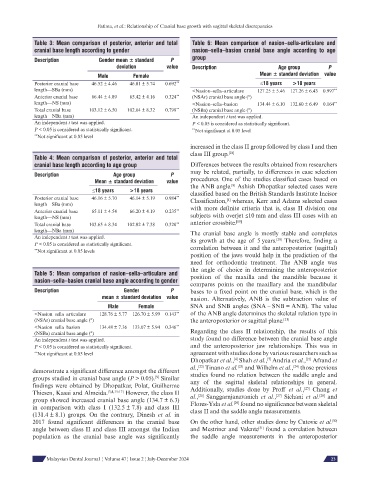
            Table  3:  Mean  comparison  of  posterior,  anterior  and  total   Table 6: Mean comparison of nasion–sella-articulare and
            cranial base length according to gender              nasion–sella–basion cranial base angle according to age
                                                                 group
            Description           Gender mean ± standard   P
                                        deviation       value    Description                 Age group        P
                                 Male        Female                                    Mean ± standard deviation  value
            Posterior cranial base   46.52 ± 4.46  46.01 ± 5.74  0.692 **              ≤18 years  >18 years
            length—SBa (mm)                                      <Nasion–sella–articulare   127.25 ± 5.46  127.26 ± 6.43  0.997 **
            Anterior cranial base   66.44 ± 4.89  65.42 ± 4.16  0.324 **  (NSAr) cranial base angle (°)
            length—NS (mm)                                       <Nasion–sella–basion   134.44 ± 6.10  132.60 ± 6.49  0.164 **
            Total cranial base   103.12 ± 6.50  102.64 ± 8.32  0.798 **  (NSBa) cranial base angle (°)
            length—NBa (mm)                                      An independent t test was applied.
            An independent t test was applied.                   P < 0.05 is considered as statistically significant.
            P < 0.05 is considered as statistically significant.  ** Not significant at 0.05 level
            ** Not significant at 0.05 level
                                                                increased in the class II group followed by class I and then
                                                                class III group. [18]
            Table  4:  Mean  comparison  of  posterior,  anterior  and  total
            cranial base length according to age group          Differences between the results obtained from researchers
                                                                may be related, partially, to differences in case selection
            Description                Age group          P
                                Mean ± standard deviation  value  procedures. One of the studies classified cases based on
                                                                              [9]
                                                                the ANB angle.  Ashish Dhopatkar selected cases were
                                ≤18 years   >18 years           classified based on the British Standards Institute Incisor
            Posterior cranial base   46.16 ± 5.70  46.14 ± 5.19  0.984 **  Classification,  whereas, Kerr and Adams selected cases
                                                                            [4]
            length—SBa (mm)                                     with more definite criteria that is, class II division one
            Anterior cranial base   65.11 ± 4.54  66.20 ± 4.19  0.235 **
            length—NS (mm)                                      subjects with overjet ≤10 mm and class III cases with an
                                                                               [19]
            Total cranial base   103.65 ± 8.34  102.02 ± 7.38  0.320 **  anterior crossbite.
            length—NBa (mm)                                     The cranial base angle is mostly stable and completes
            An independent t test was applied.                  its growth at the age of 5 years.  Therefore, finding a
                                                                                            [20]
            P < 0.05 is considered as statistically significant.  correlation between it and the anteroposterior (sagittal)
            ** Not significant at 0.05 levels
                                                                position of the jaws would help in the prediction of the
                                                                need for orthodontic treatment. The ANB angle was
                                                                the  angle  of  choice  in  determining  the  anteroposterior
            Table 5: Mean comparison of nasion–sella–articulare and   position of the maxilla and the mandible because it
            nasion–sella–basion cranial base angle according to gender
                                                                compares points on the maxillary and the mandibular
            Description                   Gender          P     bases to a fixed point on the cranial base, which is the
                                   mean ± standard deviation  value  nasion. Alternatively, ANB is the subtraction value of
                                     Male      Female           SNA and SNB angles (SNA – SNB = ANB). The value
            <Nasion–sella–articulare   128.76 ± 5.77  126.70 ± 5.99  0.143 **  of the ANB angle determines the skeletal relation type in
            (NSAr) cranial base angle (°)                       the anteroposterior or sagittal plane. [21]
            <Nasion–sella–basion   134.48 ± 7.36  133.07 ± 5.94  0.346 **
            (NSBa) cranial base angle (°)                       Regarding the class II relationship, the results of this
            An independent t test was applied.                  study found no difference between the cranial base angle
            P < 0.05 is considered as statistically significant.  and the anteroposterior jaw relationships. This was in
            ** Not significant at 0.05 level                    agreement with studies done by various researchers such as
                                                                                                      [21]
                                                                                         [7]
                                                                Dhopatkar et al.,  Shah et al.,  Andria et al.,  Afrand et
                                                                              [4]
                                                                al.,  Tinano et al.  and Wilhelm et al.,  those previous
                                                                   [22]
                                                                                [23]
                                                                                                  [24]
            demonstrate a significant difference amongst the different
            groups studied in cranial base angle (P > 0.05).  Similar   studies found no relation between the saddle angle and
                                                    [9]
            findings were obtained by Dhopatkar, Polat, Guilherme   any of the sagittal skeletal relationships in general.
                                                                                                      [25]
            Thiesen, Kasai and Almeida. [3,4,15-17]  However, the class II   Additionally, studies done by Proff  et al.,  Chang  et
                                                                                                           [28]
                                                                                            [27]
                                                                   [26]
            group showed increased cranial base angle (134.7 ± 6.3)   al.,  Sanggarnjanavanich  et al.,  Sichani  et al.  and
                                                                              [29]
            in comparison with class I (132.5 ± 7.8) and class III   Flores-Ysla et al.  found no significance between skeletal
            (131.4 ± 8.1) groups. On the contrary, Dinesh  et al. in   class II and the saddle angle measurements.
            2017 found significant differences in the cranial base   On the other hand, other studies done by Cutovic et al.
                                                                                                               [30]
            angle between class II and class III amongst the Indian   and Mestriner and Valente  found a correlation between
                                                                                       [31]
            population as the cranial base angle was significantly   the saddle angle measurements in the anteroposterior
                    Malaysian Dental Journal  ¦ Volume 47 ¦ Issue 2 ¦ July-December 2024                      23

