


Page 30 - MDJ Volume 47 Number 2 ( Jul-Dec 2024)
P. 30
Fatima, et al.: Relationship of Cranial base growth with sagittal skeletal discrepancies

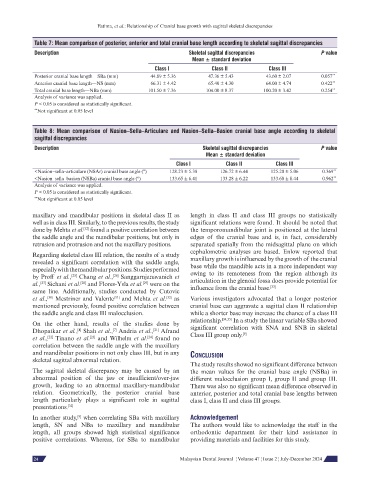
            Table 7: Mean comparison of posterior, anterior and total cranial base length according to skeletal sagittal discrepancies
            Description                                         Skeletal sagittal discrepancies            P value
                                                                 Mean ± standard deviation
                                                    Class I            Class II           Class III
            Posterior cranial base length—SBa (mm)  44.89 ± 5.36      47.36 ± 5.43       43.60 ± 2.07      0.057 **
            Anterior cranial base length—NS (mm)   66.31 ± 4.42       65.40 ± 4.30       64.00 ± 4.74      0.422 **
            Total cranial base length—NBa (mm)    101.50 ± 7.36      104.00 ± 8.37      100.20 ± 3.42      0.254 **
            Analysis of variance was applied.
            P < 0.05 is considered as statistically significant.
            ** Not significant at 0.05 level


            Table 8: Mean comparison of Nasion–Sella–Articulare and Nasion–Sella–Basion cranial base angle according to skeletal
            sagittal discrepancies
            Description                                             Skeletal sagittal discrepancies        P value
                                                                     Mean ± standard deviation
                                                           Class I          Class II        Class III
            <Nasion–sella–articulare (NSAr) cranial base angle (°)  128.23 ± 5.38  126.72 ± 6.44  125.20 ± 5.06  0.369 **
            <Nasion–sella–basion (NSBa) cranial base angle (°)  133.65 ± 6.41  133.28 ± 6.22  133.60 ± 8.44  0.962 **
            Analysis of variance was applied.
            P < 0.05 is considered as statistically significant.
            ** Not significant at 0.05 level


            maxillary and mandibular positions in skeletal class II as   length in class II and class III groups no statistically
            well as in class III. Similarly, to the previous results, the study   significant relations were found. It should be noted that
            done by Mehta et al.  found a positive correlation between   the temporomandibular joint is positioned at the lateral
                             [32]
            the saddle angle and the mandibular positions, but only in   edges of the cranial base and is, in fact, considerably
            retrusion and protrusion and not the maxillary positions.  separated spatially from the midsagittal plane on which
                                                                cephalometric analyses are based. Enlow reported that
            Regarding skeletal class III relation, the results of a study   maxillary growth is influenced by the growth of the cranial
            revealed  a  significant  correlation  with  the  saddle  angle,   base while the mandible acts in a more independent way
            especially with the mandibular positions. Studies performed   owing to its remoteness from the region although its
                                      [26]
            by Proff et al.,  Chang et al.,  Sanggarnjanavanich et   articulation in the glenoid fossa does provide potential for
                         [25]
            al.,  Sichani et al.  and Flores-Ysla et al.  were on the   influence from the cranial base. [33]
                            [28]
              [27]
                                                [29]
            same line. Additionally, studies conducted by Cutovic
                 [30]
                                       [31]
                                                        [32]
            et al.,  Mestriner and Valente  and Mehta et al.  as   Various investigators advocated that a longer posterior
            mentioned previously, found positive correlation between   cranial base can aggravate a sagittal class II relationship
            the saddle angle and class III malocclusion.        while a shorter base may increase the chance of a class III
                                                                relationship. [34,35]  In a study the linear variable SBa showed
            On the other hand, results of the studies done by
            Dhopatkar et al.,  Shah et al.,  Andria et al.,  Afrand   significant correlation with SNA and SNB in skeletal
                           [4]
                                      [7]
                                                    [21]
                                                                                 [9]
            et al.,  Tinano  et al.  and Wilhelm  et al.  found no   Class III group only.
                               [23]
                                                  [24]
                 [22]
            correlation between the saddle angle with the maxillary
            and mandibular positions in not only class III, but in any   conclusIon
            skeletal sagittal abnormal relation.
                                                                The study results showed no significant difference between
            The sagittal skeletal discrepancy may be caused by an   the mean values for the cranial base angle (NSBa) in
            abnormal position of the jaw or insufficient/over-jaw   different malocclusion group I, group II and group III.
            growth, leading to an abnormal maxillary-mandibular   There was also no significant mean difference observed in
            relation.  Geometrically,  the  posterior  cranial  base   anterior, posterior and total cranial base lengths between
            length particularly plays a significant role in sagittal   class I, class II and class III groups.
            presentations. [32]
            In another study,  when correlating SBa with maxillary   Acknowledgement
                           [9]
            length, SN and NBa to maxillary and mandibular      The authors would like to acknowledge the staff in the
            length, all groups showed high statistical significance   orthodontic department for their kind assistance in
            positive correlations. Whereas, for SBa to mandibular   providing materials and facilities for this study.
                                                        56   Malaysian Dental Journal  ¦ Volume 47 ¦ Issue 2 ¦ July-December 2024
            24

